

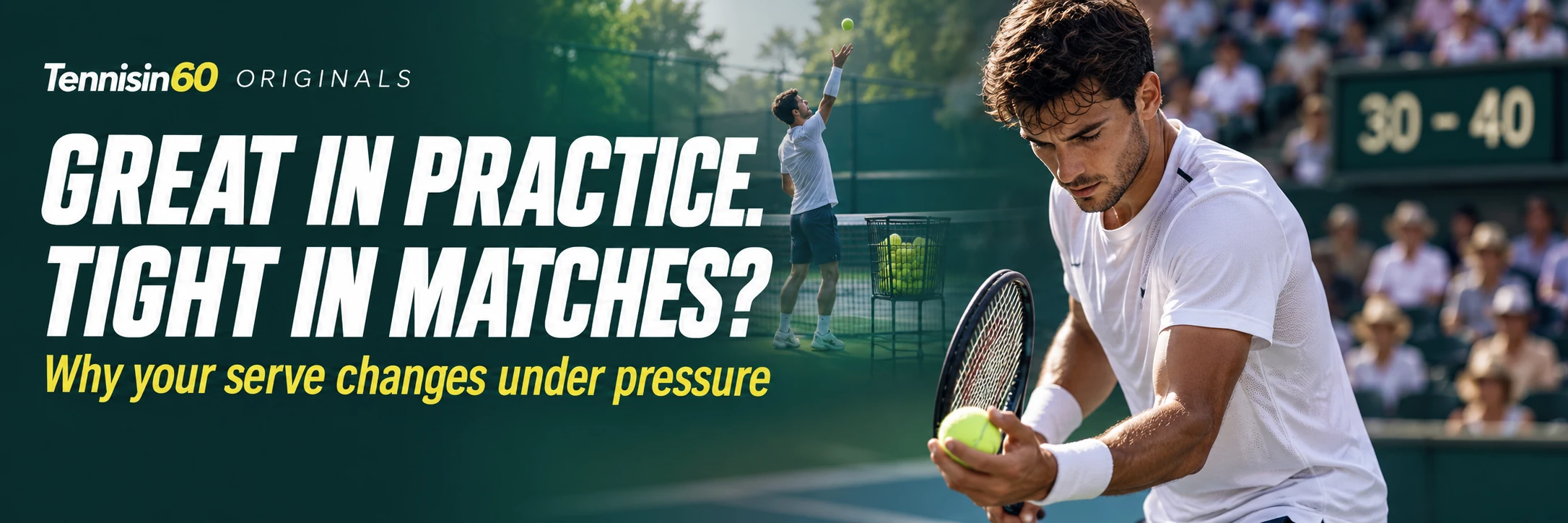
You finish practice feeling confident. Your first serve has pace, your second serve clears the net comfortably, and you can direct the ball toward different parts of the service box.
Then the match starts.
At 30–40, the toss feels unfamiliar. Your arm tightens. After missing the first serve, you guide the second into the net.
“I was serving so well yesterday.”
It is a familiar tennis frustration. But describing it simply as a lack of confidence misses an important question: Did practice prepare you for the task you are now facing?
Serving repeatedly from a basket and serving after a long rally, against an opponent, with a score attached are different experiences. Your technique matters in both. So do your preparation, attention and decisions.
The following examples are illustrative coaching scenarios, rather than accounts of named players.
The Basket Can Give You a Misleading Picture
Imagine a player hitting 40 serves from the same side of the court.
The first few miss. Then the player finds a rhythm. The toss settles, contact improves, and several excellent serves follow.
Those final deliveries may be the ones the player remembers.
In a match, however, there is no opportunity to hit six consecutive serves before choosing the best one. You alternate service courts, wait through points, respond to the returner and begin again after movement or disappointment.
A serve that becomes reliable after several repetitions has shown useful progress. It has not yet demonstrated that it can restart reliably between points.
This is one reason to distinguish practice quality from match readiness.
Keep the basket work. Use it to develop technique and placement. But also practise serving one point at a time, with the same pauses and decisions that competition requires.
The LTA recommends starting practice points with a serve to make practice more representative of match play. [1]
Pressure Can Change Your Rhythm
At 40–0, a player might bounce the ball, look toward the target and swing freely.
At break point, that same player may rush the preparation—or hesitate so long that the movement loses its familiar rhythm.
The ITF identifies rushing, excess muscle tension and disrupted breathing as problems that can accompany competitive anxiety. Its guidance emphasizes managing those responses rather than expecting nervousness to disappear. [2]
For a server, the practical question is: What changes when the score becomes uncomfortable?
A coach watching from behind the court might notice a quicker toss, a tighter grip or less time spent settling before the motion. The player may simply report that the serve “feels wrong.”
Neither observation should automatically trigger a technical rebuild. First compare the preparation and rhythm with those used when serving comfortably.
Sometimes the difference begins before the racket moves.
You May Start Giving Yourself Too Many Instructions
After a double fault, the internal conversation can become crowded:
“Keep the tossing arm up.”
“Bend the knees.”
“Don’t drop the head.”
“Reach higher.”
“Make sure this one goes in.”
Technical instruction has a place in learning. During a match, however, trying to manage several moving parts at once can leave a player without a clear intention for the serve.
A more practical approach is to select a familiar cue developed during training: perhaps a target, a rhythm word or a simple reminder agreed with a coach.
The Association for Applied Sport Psychology recommends performance routines that include releasing the previous point, choosing the next strategy and using a cue to bring attention back to the present. [3]
The cue should mean something to the individual player. Borrowing a professional’s favourite phrase is less useful than finding one that helps you execute your own movement.
“Just Get It In” Can Become an Unhelpful Instruction
Consider a player who normally hits a second serve with spin and a comfortable margin above the net.
After two double faults, the player decides to be safer. But instead of choosing a larger target and maintaining the familiar delivery, the player slows the arm dramatically and tries to steer the ball.
That is a different movement.
For a player who has learned a spin serve, safety should be developed through an appropriate combination of spin, trajectory, placement and manageable pace. Simply reducing effort does not guarantee control.
That does not mean swinging as hard as possible. Nor should a beginner be told to manufacture a kick serve during a tense match.
The useful coaching question is:
What is the most repeatable second serve this player can execute with commitment?
Build that delivery in practice. Give it a clear target and test it against a returner. Then practise trusting it when the score matters.
The Returner Adds a Decision You Did Not Practise
An empty service box does not threaten to attack your second serve.
An opponent standing inside the baseline does.
A returner can make you change your target late, chase extra pace or worry about the shot coming back before you have completed the serve.
For example, a player plans to serve toward the backhand. The receiver shifts position. During the toss, the server changes their mind and attempts a different placement.
The resulting fault may look technical, but the decision was unsettled.
Practise with a returner who changes position. Decide where to serve before beginning the motion. Learn which adjustments you can execute reliably.
Your goal is to make an informed choice, then give that choice a fair attempt.
A Routine Gives You a Familiar Starting Point
A pre-serve routine does not guarantee an ace or prevent every double fault. It gives you a repeatable way to prepare.
The USTA recommends developing a comfortable service ritual and using it regardless of the score. That might include a consistent number of ball bounces, a breath or another familiar preparation pattern. [4]
A simple routine could be:
- Acknowledge the previous point and let it finish.
- Choose the serve and a realistic target.
- Settle your feet and take a comfortable breath.
- Use your familiar ball bounces.
- Begin the motion with one clear intention.
Use it during practice as well as matches, within the applicable time limits.
If the routine only appears at break point, it is another new behaviour introduced when you already feel uncomfortable.
Practise the Second Serve as a Separate Skill
Some players spend most of their serving session hitting first serves. Second serves receive a few hurried repetitions at the end.
Yet the second serve is the delivery they most need to trust after a miss.
Give it its own practice block.
Start with an achievable target and record every attempt. Then add a returner and play the point. Notice both whether the serve lands in and whether it starts a playable rally.
The LTA specifically suggests second-serve-only points as a way to introduce pressure on serve consistency. [1]
That exercise can reveal a useful distinction. A serve may land in frequently against an empty court but become unreliable when the player anticipates an aggressive return.
The next stage of training should address that situation directly.
Three Ways to Build a More Match-Ready Serve
These suggested exercises combine technical practice with decisions and scoring. Adjust the difficulty to the player.
1. The Two-Serve Sequence
Play ten points against a returner, using normal first- and second-serve rules.
Complete your routine before every point. Record first serves made, double faults and points won.
This prevents a session from becoming a collection of unrelated first-serve attempts. It also shows whether your first serve helps you begin the point effectively.
2. The 30–30 Game
Begin each service game at 30–30.
Play normally from there, including the return and rally. Repeat several games.
This gives you repeated experience of serving with something immediately at stake. Assess your choices and routine as well as the outcome.
The LTA offers a related variation: beginning service games at 0–30. [1]
3. The Target Finish
Choose a generous target area and an achievable number of successful serves needed to finish.
As you approach the target, observe whether you rush, become cautious or abandon your routine.
The USTA’s pressure-serve guidance similarly uses consecutive targets to introduce pressure into serving practice. [5]
Keep the challenge constructive. The purpose is to rehearse a response to pressure, not to turn every miss into punishment.
Check Technique and Conditions Too
Not every match-day serving problem is psychological.
Wind, sun, a different warm-up, fatigue or an inconsistent toss may affect the delivery. A technical weakness can also be easier to manage during repeated basket practice than during competition.
Ask a coach to compare practice and match footage. Look for observable differences rather than assuming every fault has the same cause.
If serving causes pain, stop treating it as a confidence problem and seek appropriate assessment.
Measure Progress Over Several Matches
One comfortable service game does not prove the problem is solved. One poor game does not erase improvement.
Track a few useful measures: double faults per service game, second-serve percentage and whether you maintained your routine on important points.
Look for patterns across comparable sessions.
A reliable match serve develops through repeated experience: selecting a sensible target, recovering after a miss and executing a familiar delivery with an opponent waiting.
You may still feel nervous at break point.
The aim is to know what to do next—and to have practised doing it.
Comments
No comments yet.