Size
The court is 78 feet long. Singles is 27 feet wide. Doubles is 36 feet wide. The net is 3 feet high at the centre and 3 feet 6 inches at the posts.
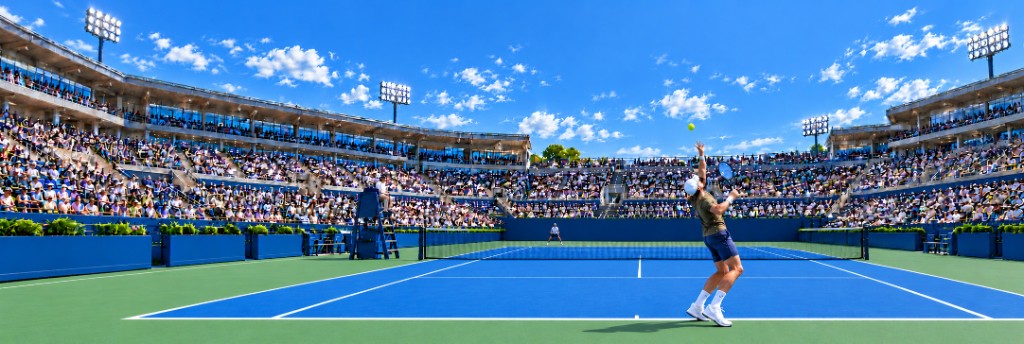
Desk guide
The playing rules below follow the Rules of Tennis published by the ITF. The 2026 English book is the official PDF. A tournament announces before the event which scoring method it will use.
The court is 78 feet long. Singles is 27 feet wide. Doubles is 36 feet wide. The net is 3 feet high at the centre and 3 feet 6 inches at the posts.
A ball that touches a line is in. The service boxes sit between the net and the service line, split by the centre service line. The server starts each game from the right.
The alleys are in play. After the return of serve, either player on a team may hit the ball. One player cannot play the match alone.
The server’s score is called first. No points is love, then 15, 30, and 40. The next point wins the game. If both sides reach 40, the score is deuce. The next point is advantage, and that side has to win the point after it as well. If the other side wins the advantage point, the score goes back to deuce.
Some events use No-Ad scoring. At deuce, one deciding point is played. The receiver chooses which side to take the serve, and the winner of that point wins the game.
The first side to win six games wins the set, and they must lead by two games. If the set reaches 6–6, a tie-break is played. The first to seven points wins it, and they must lead by two. Points in the tie-break are counted 1, 2, 3.
A match is best of three sets or best of five. At the Grand Slams, men’s singles is best of five and women’s singles is best of three. ATP and WTA matches are best of three. The Rules also allow a 10-point tie-break when the final set reaches 6–6. The Grand Slams use that tie-break to decide the match.
Before the motion, both feet are behind the baseline, between the centre mark and the sideline. The server must not touch the baseline or the court, or step outside those marks, before hitting the ball. That is a foot fault.
The serve has to cross the net and land in the service box diagonally opposite. A miss is a fault. A second miss is a double fault, and the server loses the point. In a standard game the serve starts on the right and then alternates.
If the serve clips the net and still lands in the correct box, the serve is taken again. It does not count as a fault. A serve that clips the net and misses the box is a fault.
You win the point if the ball bounces twice on the other side of the net, or if the other side hits it out, into the net, or into a permanent fixture before it bounces. You lose the point if you hit the ball twice, touch the net, or let the ball touch you or your clothing while it is in play.
Players change ends after the first game, the third, and every odd game after that. In a tie-break they change ends after every six points. The toss before the warm-up decides who serves first and which end each side starts on.
History of Tennis · Grand Slams · ATP Finals · WTA Finals