

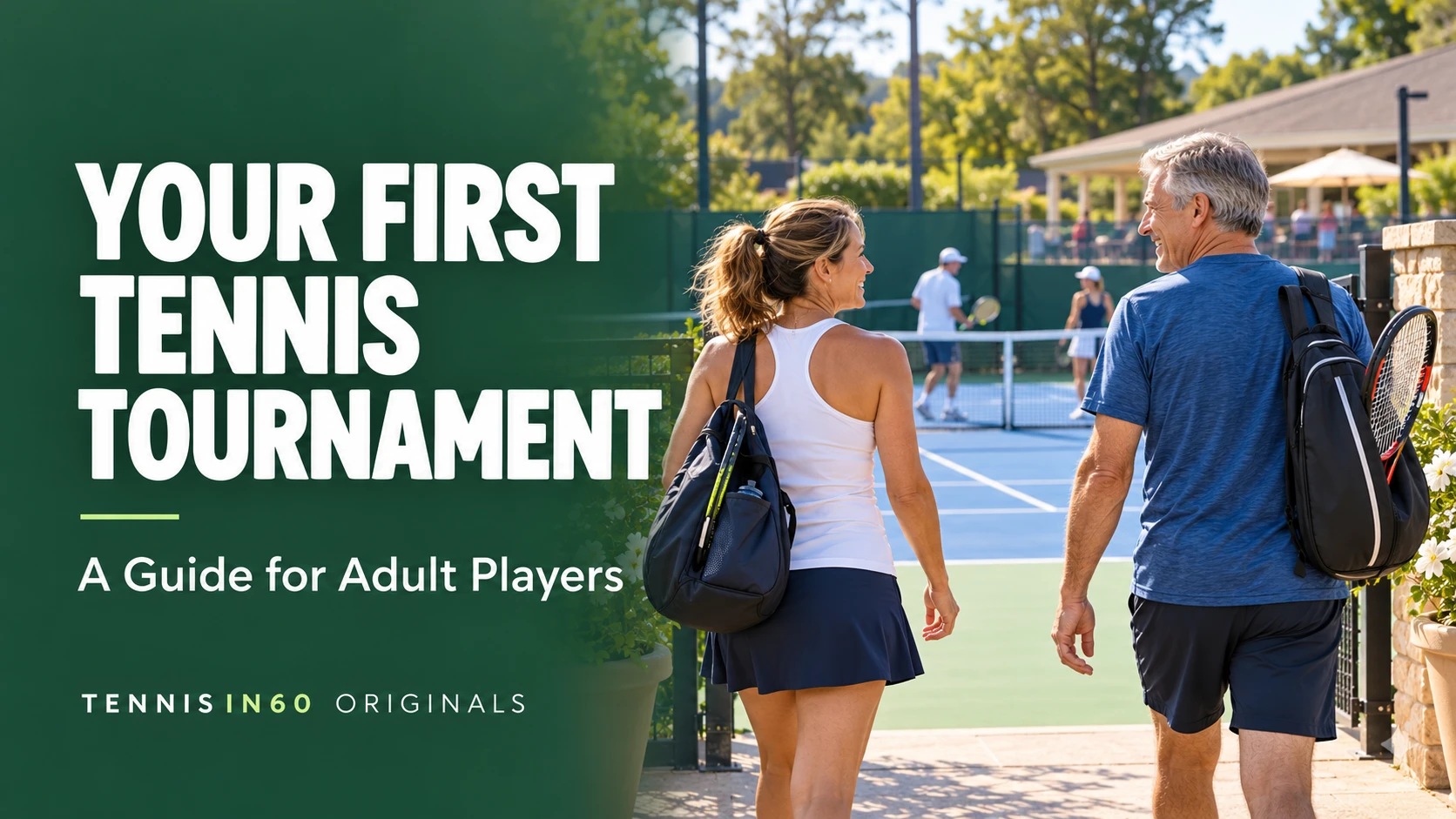
Your first event should give you a reason to return
You do not need to be a former junior champion to enter a tennis tournament. Adults who learned the game later, returned after a long break or usually play social doubles can find suitable competition. The important decision is choosing an event whose standard, format and schedule fit your current game.
A sensible first goal is to complete the experience: enter correctly, arrive prepared, manage the scoring and compete with the skills you already have. Winning is enjoyable, but it is a poor measure of whether your first event was worthwhile. A close loss can reveal more useful information than an easy win in the wrong category.
This guide focuses on adult recreational competition in Canada, with a short explanation of American and international alternatives. Local regulations and individual tournament factsheets determine eligibility, scoring and fees. Read them before entering rather than assuming every tournament follows the same arrangements.
Choose the kind of competition you want
A club or community tournament can provide a familiar introduction, particularly if you already know the venue and some of the players. Ask whether it welcomes non-members and whether divisions are organised by level. An event can be friendly and well run without awarding official ranking points.
A sanctioned tournament belongs to a recognised competition structure and may require provincial or territorial association membership. Tennis Canada’s calendar includes adult rating categories, Masters events and Open competitions, with filters for location, dates and singles or doubles. It is a useful starting point for finding an event close to home. 1
For a first attempt, favour a manageable journey and a clearly described division. Being able to sleep at home, bring familiar food and practise on a similar surface removes several complications. If a weekend tournament feels like too large a step, a club ladder, box league or organised match-play session can provide an intermediate experience.
Match the division to your ordinary game
A playing rating describes ability; a ranking reflects position within a competition system. Neither is a guarantee of what will happen in one match. A player can be consistent in practice but inexperienced at keeping score under pressure, while an opponent with less spectacular strokes may compete very effectively.
Tennis Canada’s self-rating guide recommends choosing the description that reflects your general play and asking an instructor or coach to validate it when helpful. Assess your second serve, return and movement as honestly as your favourite forehand. A level should describe what you can normally do against an opponent, rather than your best five minutes on a comfortable feed. 2
In broad terms, the guide describes a 3.0 player as able to sustain moderate-paced forehand and backhand exchanges, while 3.5 includes greater ability to move an opponent and attack easier balls. These are abbreviated illustrations, not complete eligibility definitions. Read the full guide and the event’s entry conditions. 2
Tennis BC uses NTRP categories alongside World Tennis Number information in its adult structure. Its guidance includes different recommendations for some men’s and women’s categories and specific treatment of doubles. Avoid treating one rating scale as a universal conversion into another. If you have no established match history or are uncertain about eligibility, ask the organiser before paying. 3
Do not choose a weaker category merely to improve your chance of winning. Equally, there is no benefit in entering a much stronger field because its label sounds more impressive. Competitive points against appropriate opposition are the useful target.
Age groups do not tell you the playing standard
Masters tennis offers competition for adults aged 30 and over. ITF age groups progress in five-year increments from 30+ through 90+. For ITF Masters, eligibility is based on birth year: a player qualifies for the relevant age group in the calendar year in which they reach that age. Confirm the rules for a domestic event instead of automatically applying an international provision. 4
An age category is not a beginner category. A 60+ or 70+ draw can contain experienced national and international competitors. If you are beginning tournament play at 65, your age may make you eligible for a division, but it does not establish that the division is a suitable competitive introduction.
Ask about the likely field and whether a rating-based event would be a better first choice. An older player may find closer matches in an appropriate recreational rating division than in an unrestricted age-group championship. The reverse can also be true for an experienced player seeking peers of a similar age.
The same caution applies to Open events. Check the organiser’s description and entry requirements. Open should not be read as a promise of beginner-friendly competition.
Choose singles or doubles deliberately
Singles gives you responsibility for every shot and every tactical decision. It can suit a player who wants to learn how their serve, return, movement and concentration hold up throughout a match. It also means covering the full singles court and managing the contest without a partner.
Doubles offers shared decision-making and can be a comfortable first step for regular social doubles players. Choose a partner with compatible expectations about preparation, communication and results. Agree who handles registration, how you will communicate schedule changes and whether you both intend to remain available through the final day.
Doubles entry is not always complete when one partner submits a form. For example, Tennis BC’s November 6–8, 2026 Richmond event specifies that both players must enter to complete team registration. Treat this as an example of a requirement to check, rather than assume the same process everywhere. 5
Entering singles and doubles in the same tournament adds court time but also scheduling and recovery demands. For a first event, one division may be enough to learn the process without making the weekend unnecessarily complicated.
Understand the format before comparing prices
In straight knockout competition, a first-round loss can end your participation unless another draw or consolation opportunity is offered. A round robin schedules play within a group. Other formats can add placement matches, consolation draws or shortened scoring. Ask what is actually offered rather than relying on the word tournament.
A round robin can be attractive when your main objective is gaining experience, but scheduled matches are not the same as an unconditional guarantee of completed play. Withdrawals, weather and operational changes can affect the programme. Read any minimum-match promise and its exceptions.
Check whether matches use full sets, short sets, no-ad scoring or a match tiebreak instead of a deciding set. Practise the advertised format beforehand. The tournament court is an uncomfortable place to discover that you do not understand how the deciding tiebreak works.
Find out how many matches may be scheduled in a day and whether consolation participation requires a separate sign-up. Those answers help you judge both value and workload.
What does a first tournament cost
There is no single Canadian entry price. As published examples, Victoria’s June 2026 Summer Open listed singles at $60 and doubles at $40 per player. The 2026 Stanley Park Open NTRP event listed $80 for singles and $70 per doubles player. Tennis BC’s November 2026 Richmond event lists $70 singles and $55 per doubles player. These are individual event examples, not a national fee range or a promise about future editions. 567
Association membership can be a separate expense. Tennis BC’s published adult membership price is $49, while its free recreational membership does not permit entry into sanctioned tournaments. Some eligible club members may have their association fee covered through their club’s membership arrangements; verify that before buying twice. Other provinces have their own requirements and prices. 8
Using the Richmond singles fee as an illustration, a player who also needs the listed $49 Tennis BC adult membership would start with $119 in entry and membership costs. That calculation excludes any checkout charges and assumes no existing membership or waiver. Travel, parking, accommodation and meals can make a distant event substantially more expensive.
Budget for the possibility of one completed match if the format is knockout. Entry fees do not purchase a particular result or a fixed number of playing hours. Review refund and withdrawal policies before committing, especially when work, travel or health could affect your availability.
Read the dates as a commitment
The tournament’s opening and closing dates define the period when you may need to play. A weekend label does not necessarily mean your first match will be Saturday afternoon. Some events begin Friday, use evening sessions or operate at more than one venue.
Read the entry deadline, withdrawal deadline and acceptance procedure separately. Submitting an entry may not guarantee a place if the draw is limited or selection rules apply. The Stanley Park event, for example, describes draw limits and an acceptance process rather than promising every applicant a place. 7
Check how schedules are published and who is responsible for monitoring changes. Do not assume someone will telephone you. If you need a scheduling exception, ask before entering and understand that a request may be declined.
Save the organiser’s contact details and the exact venue address. For a multi-site event, confirm which location applies to your match. A correct arrival time at the wrong venue is still a problem.
Prepare through match play rather than rebuilding your strokes
In the weeks before the event, practise starting points properly: serve, return and the next shot. Include complete games and the tournament’s tiebreak format. A rally drill can improve striking, but it does not reproduce the decisions involved in a second serve at 30–40.
Use a simple plan that fits your current strengths. Examples include making a dependable first return, aiming safely away from the lines during neutral rallies and recovering promptly after each shot. Choose one or two priorities that you can remember when the score becomes uncomfortable.
Avoid a major equipment experiment immediately before the tournament. Bring a familiar racquet setup, and a suitable spare if you have one. Test shoes in normal practice before relying on them for a competitive match. If a new string or grip is needed, leave enough practice time to become comfortable with it.
Build your preparation around the workload you already tolerate. Do not suddenly add several exhausting sessions to prove you are ready. If an existing injury or health condition raises questions about competing, seek appropriate individual advice rather than using a general tournament guide as clearance to play.
Pack for waiting as well as playing
Bring racquets, clean grips, suitable shoes, water, familiar snacks, towels and a change of clothing. Add sun protection and weather layers for outdoor events. Confirm whether match balls are supplied and whether there are specific clothing or footwear requirements.
Carry essential contact details and keep your phone charged for scheduling updates. Think about parking, transport and how you will get food between matches. Bring enough equipment to handle a string break or wet clothing without making a rushed trip home.
Waiting is part of many tournament days. A delayed start can leave you either stiff from sitting or tired from repeatedly warming up. Stay near enough to hear instructions, move periodically and ask the desk how the order of play is progressing.
What happens when you arrive
As a practical planning target, allow around 30 minutes before your listed time, or longer if the tournament requires earlier check-in. This is an editorial recommendation, not a universal rule. The event’s instructions take precedence.
Check in with the tournament desk, confirm your division and ask where to wait. Establish who supplies the balls, how you will be called and where to report the score. Tell the organiser promptly if an issue could affect your participation.
Complete your own physical warm-up before you are called to court. The on-court warm-up is a limited opportunity to get accustomed to the ball and surroundings with your opponent. It is not a private lesson or the time to begin preparing your body from rest.
If you are running late, contact the tournament immediately and ask for the referee’s instructions. A telephone call does not automatically excuse lateness or protect you from penalties. Do not rely on a friend’s interpretation of a rule.
Know the scoring and conduct expected on court
Read Tennis Canada’s current Rules of the Court and its guidance for unofficiated matches before your event. Many first-time players will need to manage a match without a chair umpire. The tournament referee remains the appropriate person to resolve questions that you cannot settle correctly between yourselves. 9
Know your own responsibilities for scorekeeping, line calls and the service order. Announce scores clearly and resolve uncertainty before beginning another point. If a disagreement persists, pause and request the proper assistance rather than inventing an arrangement under pressure.
A competitive match does not require hostility. Give your opponent time to be ready, keep communication brief and courteous, and use the procedures established for the event. Learn how to request an official before a small disagreement becomes the main story of your first tournament.
Treat your first result as useful information
Expect some difference between practice and competition. An unfamiliar opponent, a scoreboard and the knowledge that a result will be recorded can change your decisions. That experience is something to learn from rather than evidence that your practice has been wasted.
Between points, use a short routine: acknowledge what happened, choose the next intention and prepare. Avoid diagnosing every stroke after every error. If your ambitious target is not working, choose a safer one without abandoning your entire game plan.
After the match, confirm the result with your opponent and follow the reporting procedure. Before leaving, check whether you have another main-draw, round-robin or consolation match and when the next schedule will be available.
Write down three useful observations: one thing that held up, one pattern that cost points and one specific task for practice. That gives your next session a purpose. A score alone cannot tell you whether the next improvement should be a return, a more reliable second serve or better recovery after a wide ball.
A brief guide to playing outside Canada
The USTA offers rating-based, age-division and Open tournaments in the United States. Its adult tournament guidance distinguishes age divisions from NTRP competition. A familiar rating label should not be treated as automatic eligibility: check the specific event’s membership, rating and entry conditions, especially as a visitor from another country. 10
For international Masters tennis, the ITF provides an online entry and membership service now described as World Tennis Tour Zone, previously known as IPIN. Age eligibility and registration are required; event entry fees and any applicable tour charges should be checked in the current factsheet. Do not assume that international competition is reserved exclusively for former professionals, but choose the event and field carefully. 4
Start with a tournament you can understand
A suitable first tournament has a clear category, manageable travel, a format you understand and a schedule you can honour. You should know what you are paying, whether you have been accepted and what happens if your opening match ends in defeat.
You do not have to wait until every stroke feels finished. Tennis rarely provides that moment. Choose appropriate competition, prepare the practical details and give yourself permission to learn how tournament play feels. The best first event is one that makes you want to enter a second.
Editorial method
This article combines practical editorial guidance with official Canadian, American and international competition resources checked on October 26, 2026. Published 2026 entry fees are examples from named events, including events already completed, rather than advertised availability or national averages. Eligibility, fees, acceptance, scoring, cancellations and schedules vary. Consult the relevant association and the current tournament factsheet before entering. No entry has been submitted on a reader’s behalf.
Sources
- [1] Tennis Canada tournament calendar Open source
- [2] Tennis Canada self rating guide Open source
- [3] Tennis BC adult competition guidance Open source
- [4] ITF Masters eligibility and online entry Open source
- [5] Richmond November 2026 event Open source
- [6] Victoria Summer Open 2026 Open source
- [7] Stanley Park Open NTRP 2026 Open source
- [8] Tennis BC membership types Open source
- [9] Tennis Canada Rules of the Court 2026 Open source
- [10] USTA adult tournaments Open source
Comments
No comments yet.