

For generations, players have heard a familiar serving instruction: toss toward one o’clock if you are right-handed, or eleven o’clock if you are left-handed. That cue can help a beginner, but a powerful serve requires more than finding a number on an imaginary clock. The ball must meet a moving player whose legs, trunk and hitting arm are working together.
Many accomplished servers appear to contact the ball closer to the line above their head while moving forward into the court. That observation raises a useful coaching question: how does contact position allow the body to contribute to the strike? Research supports studying the relationship between toss, body position and racket motion. It does not establish that every leading player uses one toss, or that moving a toss centrally will automatically increase speed.
The clock face leaves out depth
Here, imagine a clock viewed from behind the server: twelve above the head, one toward a right-hander’s hitting side and eleven toward a left-hander’s hitting side. The limitation is that this describes only a two-dimensional picture. The ball also has height and depth into the court, and the body changes position after release.
A toss that begins forward of the player can look almost overhead when the player drives beneath it. Toss release, toss peak and racket–ball contact are different events. A single still photograph cannot establish where the ball started or how the body arrived beneath it. Film from behind to assess sideways placement and from the side to assess forward reach.
Where contact belongs relative to the moving body
For a power-oriented first serve, contact generally occurs high and forward relative to the player’s body at that instant. It need not sit directly above the head, and the appropriate sideways relationship depends on stance, body tilt, serve direction and individual technique. The useful target is a reachable strike zone through which the racket can accelerate without a last-second sideways chase.
The head is not a fixed landmark. As the legs extend, the trunk tilts and the hitting shoulder rises, the head and shoulders move beneath the ball. A player can therefore look as though the ball is above the head from behind while a side view shows contact forward into the court. Those views describe the same three-dimensional action.
Partly turned at contact: avoid opening too early
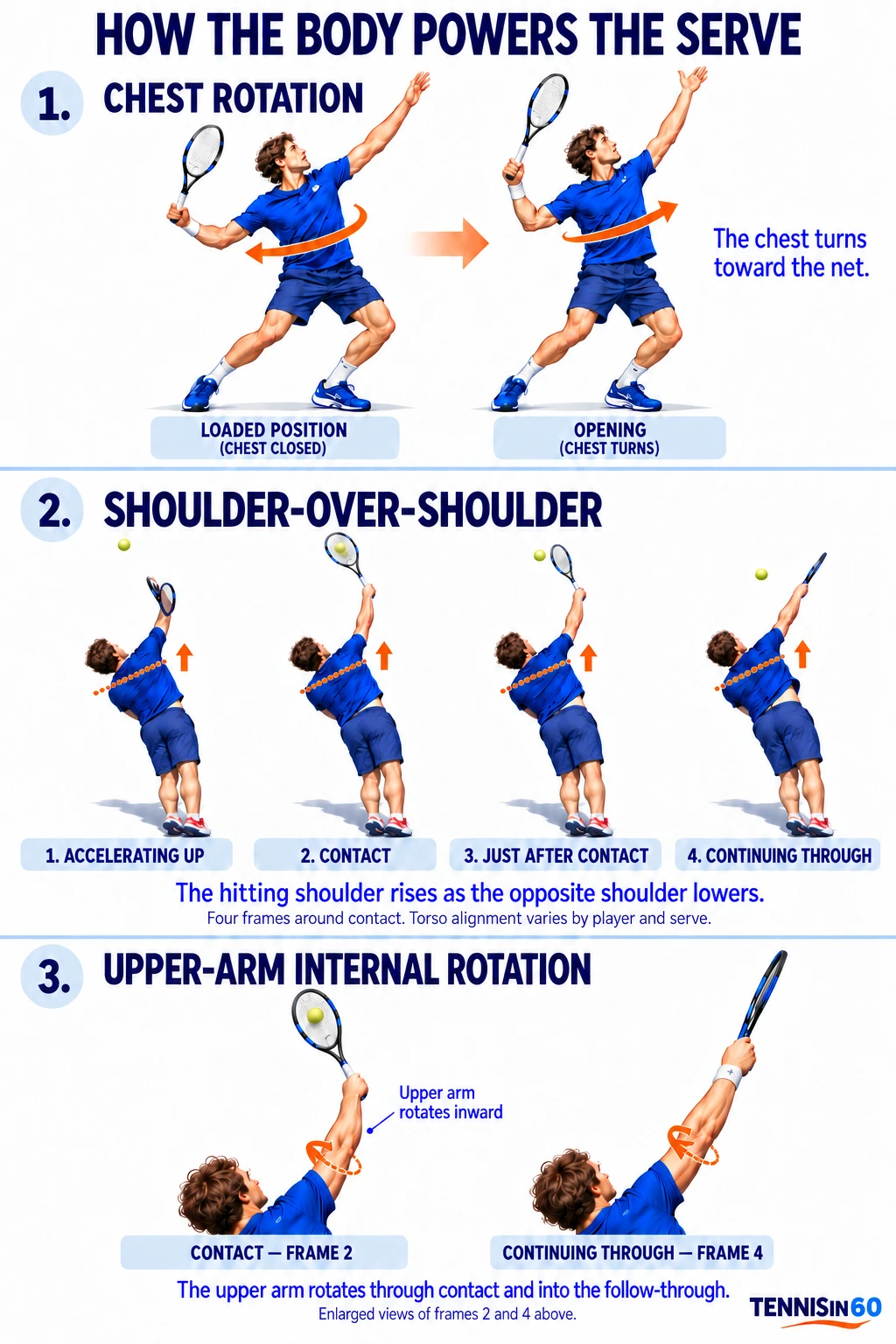
An important coaching observation is that a server can reach contact with the torso still partly turned. The shoulders and chest do not have to finish facing directly toward the net before the racket reaches the ball. The hitting shoulder can rise through the strike while the body continues its coordinated motion.
We need to define the reference carefully. A shoulder line parallel to the baseline corresponds approximately to a chest facing toward the net. A shoulder line angled to the baseline represents a partly turned torso. Because coaches use “square” in different ways, video analysis should state which line is being compared with the baseline and which camera angle is being used.
The practical interpretation is to avoid forcing the chest open prematurely just to face the target. For some players, opening too early disrupts the timing between the trunk and hitting arm and encourages a compensating reach. However, deliberately holding the torso closed can also interfere with the swing. Partial turn is a feature to assess within the whole motion, not a position to freeze.
There is no single shoulder angle that every server must copy. Flat, slice and kick serves, different target directions and different players can show different alignments. A tilted shoulder line in a rear photograph also does not, by itself, measure how far the chest has rotated horizontally. Both perspectives matter.
How the body contributes power
It is tempting to describe this as putting body weight through the ball. The more precise explanation is that ground forces and coordinated joint movements help accelerate the racket. The legs push against the court, the body rises and moves forward, and trunk and arm motions contribute to the speed and orientation of the strings at impact. Body mass alone is not a source of extra speed.
Forward movement can contribute to the racket’s motion and help position contact farther into the court, but moving farther forward does not guarantee a faster or better serve. The ball responds to the racket–ball collision, including racket speed, face orientation and the impact location. A controlled, repeatable sequence matters more than a dramatic leap.
The ball is on the strings only briefly. Movement after separation cannot add force to a ball that has already left the racket. A flowing follow-through is useful as evidence that the action was not abruptly interrupted before contact; it should not be described as pushing the ball toward the service box for an extended time.
Three movements that work together
First is chest rotation: the torso turns from its loaded orientation toward a more open position. Second is shoulder-over-shoulder motion: the shoulder line changes tilt as the hitting shoulder rises and the opposite shoulder lowers. These describe different aspects of trunk movement and can occur together.
Third is upper-arm internal rotation. The humerus turns around its long axis within the shoulder socket. This contributes importantly to racket acceleration and is distinct from forearm pronation, in which the radius rotates around the ulna. Elbow extension and forearm rotation also affect the visible racket path, so a change in racket-face appearance alone cannot isolate the contribution of the shoulder.
What a more central toss can—and cannot—change
If the ball is too far toward the hitting side for a player’s action, that player may reach sideways or rearrange the swing to find it. Bringing the toss toward a better overhead corridor may improve the fit between upward drive, torso motion and contact. That is a coaching interpretation of the mechanics, not proof that a central toss is best for everyone.
The opposite errors matter too. Too far across the head can demand unwanted compensation; too far forward can make the player chase the ball. Evaluate a small change by its results: repeatable contact, placement, speed, spin and balance. A serve that looks more like a professional’s photograph is not automatically more effective.
Kick serves: contact shifts to support the upward swing
For a right-hander, kick contact generally shifts farther left relative to flat or slice contact, with left-handers broadly mirroring the relationship. It is often less far forward relative to the moving body, supporting a stronger upward component through the strike. This does not mean throwing the ball far behind the back.
A study of ten right-handed professional men found kick contact approximately 30 centimetres farther toward the receiver’s right than slice contact—toward the server’s left. That was a difference observed within that sample, not a universal instruction to move every player’s toss by 30 centimetres. The LTA similarly describes the kick toss as more overhead.
Slice serves need a separate explanation
Slice and kick should not be grouped under one instruction to toss to the opposite side of the head. A right-hander’s slice contact commonly remains forward and toward the hitting side relative to kick contact. Spin comes from the relationship between racket travel, string orientation and ball contact, not from toss location alone.
Slice produces a substantial sideways spin component. Kick combines spin components that help the ball dip and influence its bounce. Both require a coordinated strike, and neither is adequately explained by a wrist snap. The toss should make the intended impact possible without forcing an exaggerated reach.
A practical way to coach the contact point
Record several serves from behind and from the side. Identify contact, then examine the body at that same instant: head, shoulder line, torso orientation, feet and racket. Compare serves to similar targets rather than mixing every direction and spin. Look for patterns across several deliveries, not one ideal frame.
Try small toss adjustments and track whether the player reaches contact more comfortably and repeats the intended serve more often. Keep the chest free to rotate without demanding that it become square early or remain closed artificially. For developing players, preserve a smooth action before chasing extra rotation or forward travel.
The best contact point is the one that allows this player to deliver this serve with coordinated speed, useful spin and reliable placement. The toss sets the opportunity; the moving body and racket must arrive together.
Sources
- Kovacs & Ellenbecker: An 8-Stage Model for Evaluating the Tennis Serve
- Fleisig et al.: Kinematics used by world class tennis players to produce high-velocity serves
- Elliott: Biomechanics and tennis
- Carboch & Süss: Toss differences between the slice serve and the kick serve
- LTA: Flat, kick & slice—your guide to serve spins
Comments
No comments yet.