
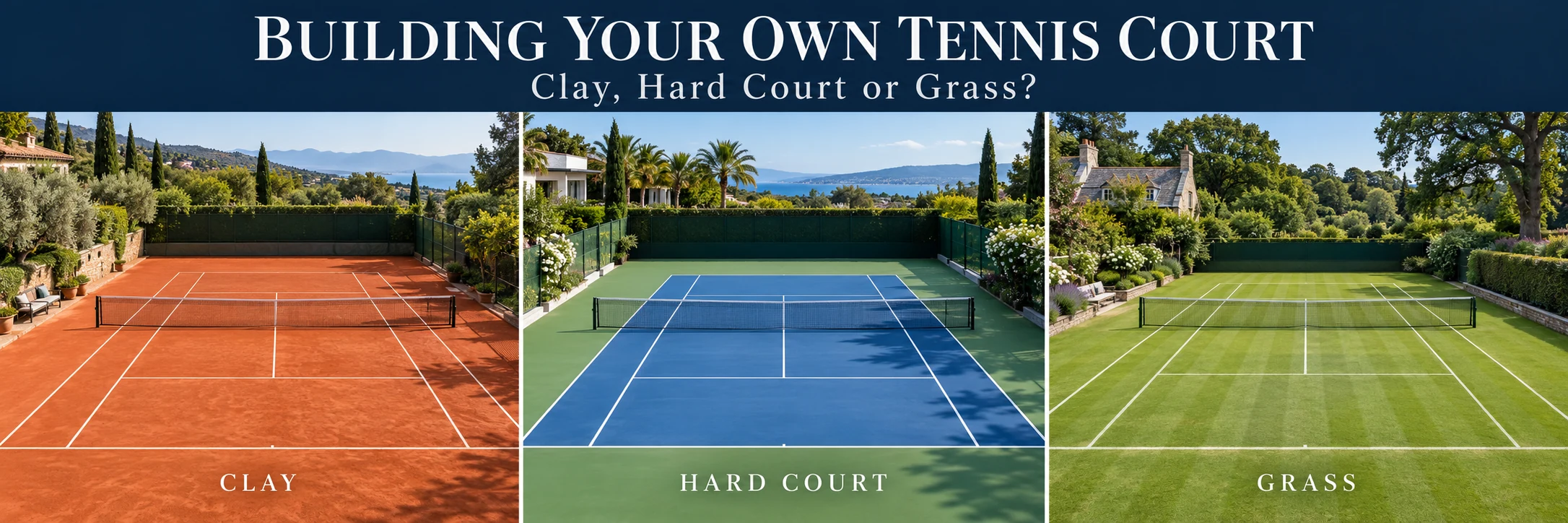
Building a private tennis court can turn a home into a place where tennis becomes part of everyday life. You can hit before work, practise a serve without booking a court, and invite friends over for doubles. The financial commitment, however, extends well beyond the coloured rectangle visible in a photograph. Ground conditions, drainage, access, lighting and the standard of finish can change the price as much as the playing surface.
For most owners seeking straightforward everyday use, an asphalt court with a specialist acrylic finish deserves the first quotation. Clay is attractive for people who enjoy its playing characteristics and can organise regular care. Natural grass requires the most deliberate commitment to specialist maintenance, suitable growing conditions and periods when the surface should rest. None of these choices compensates for poor construction underneath.
This guide covers one outdoor private court, rather than an indoor building, commercial complex or tournament stadium. Prices are in US dollars where marked US$ and Canadian dollars where marked C$. Published prices are examples from identified suppliers and contractors, checked for this article in October 2026. They are not guaranteed quotations. Planning models, labour assumptions and calculations are identified separately so readers can replace them with local numbers.
My perspective is that of a tennis coach considering how a court will actually be used. Structural design, drainage, electrical installation and turf selection require the appropriate specialists. A successful project gives its owner a playable court and a manageable routine for looking after it.
Start with a realistic construction budget
Published estimates provide a useful starting point, provided their scope stays attached to the number. HomeGuide lists US$40,000–100,000 for asphalt, US$25,000–90,000 for clay and US$45,000–110,000 for natural grass. Its guide describes preparation, materials and installation, but accessories and difficult conditions can change the final project. These are broad US estimates, not a promise that a particular property can be developed at the low end. 1
There is useful contractor evidence alongside those national estimates. Fast-Dry Courts publishes South Florida examples of US$45,000–80,000 or more for asphalt and US$40,000–80,000 or more for Har-Tru. It explicitly explains that its ballpark court prices exclude owner-provided site preparation and utility supply. Comparing that quotation with a supposedly complete package without reading the exclusions would be misleading. 2
In Ontario, CrowAll publishes approximately C$45,000–70,000 for asphalt with acrylic coating and C$70,000–110,000 for clay or synthetic clay. The clay category combines different systems, so it does not establish a separate price for a traditional red-clay court. The contractor also lists lighting separately. Confirm currency and inclusions directly when requesting a quotation. 3
| Surface | Published US starting references | Canadian starting reference |
|---|---|---|
| Asphalt with acrylic finish | US$40,000–100,000 in HomeGuide | C$45,000–70,000 in the Ontario contractor example |
| Clay | US$25,000–90,000 in HomeGuide | C$70,000–110,000 for the combined clay and synthetic clay category |
| Natural grass | US$45,000–110,000 in HomeGuide | Obtain a specialist quotation rather than assume a national price |
The table is not a comparison of identical contracts. A sloping estate, remote island, expensive urban site or property needing retaining walls can exceed every range. Land purchase, extensive landscaping, taxes, professional fees and major utility upgrades should be identified separately. Establish the scope before deciding whether a price is inexpensive.
Why Canadian and American quotations cannot simply be exchanged
A US construction price converted into Canadian dollars does not become a Canadian quotation. Labour markets, aggregate sources, freight, seasonal demand and local construction requirements differ. An Ontario contractor may have efficient access to paving equipment, while a remote British Columbia property may require expensive mobilisation before the same work begins.
Historical references also need dates. Tennis Canada’s 2019 municipal facilities framework described hard-court costs of C$75,000–150,000 and identified the base, acrylic resurfacer, colour coating and equipment as separate components. That is useful evidence of project structure and the scale of investment, but it is not a current residential price list. 4
Where this article uses Canadian equivalents for an illustrative US budget, it assumes US$1 equals C$1.40 solely to make the arithmetic transparent. That assumption is not a current exchange-rate quotation, and the converted figures do not describe Canadian market conditions. Replace it with the actual exchange rate only when purchasing imported goods; obtain local prices for local work.
The same discipline applies inside the United States. A Florida clay-court contractor working from a prepared base faces a different assignment from a builder excavating rock in New England. Ask each bidder to price the same drawing, dimensions and list of inclusions. Otherwise, the apparent saving may simply be work transferred to someone else.
Allow enough land for the court and its surroundings
A doubles court’s marked playing area measures 78 by 36 feet, or 2,808 square feet. Players also need clear space beyond the baselines and sidelines. A commonly used overall court envelope is 120 by 60 feet, covering 7,200 square feet, approximately 669 square metres. ITF guidance identifies the playing dimensions and recommended clearances; the appropriate enclosure must be confirmed for the intended standard of play. 5
That distinction has a major effect on cost. Pricing only the marked rectangle leaves out 4,392 square feet within a 120-by-60-foot enclosure. Most of the coloured pavement, much of the drainage work and the entire perimeter fence serve the larger envelope. A price per square foot is meaningful only when the contractor states which area is being measured.
The property must also accommodate construction access, drainage infrastructure and any applicable setbacks outside the enclosure. Think about where a mower, roller or maintenance cart will enter. A narrow pedestrian gate may be convenient for players but inadequate for the equipment needed later.
Orientation should be considered before the footprint becomes fixed. Nova Sports’ published construction guidance explains that sun position varies with latitude, season and time of use. A generally north–south layout is a useful starting discussion, but the designer should examine actual playing hours, shadows and the site rather than treat a compass direction as an absolute rule. 6
Walk the proposed court location at the hours you expect to play. A beautiful afternoon view may place a server directly into low sun. Trees that provide pleasant shade can also create uneven drying and a continuing supply of leaves. Those observations should inform the drawing before excavation begins.
Investigate the ground before choosing the surface
The first serious construction question is what lies beneath the proposed court. Nova Sports’ site-investigation guidance identifies organic soils, uncontrolled fill, expansive soils and high groundwater as conditions requiring particular attention. It also explains the relationship between moisture, frost-susceptible materials and movement. The necessary investigation depends on the site rather than on a single universal testing package. 7
For an owner, the practical objective is to reduce unknowns before agreeing to a fixed price. Ask who will assess bearing conditions, whether test pits or borings are appropriate, and what happens if unsuitable material is discovered. A quotation should state any allowance for excavation and the unit price for additional removal or imported fill.
An existing lawn can conceal buried rubble, old foundations or soft pockets. A surface that appears flat can still contain fill placed without controlled compaction. These conditions matter because the court needs to retain its finished shape across a much larger area than a patio or garden path.
Arrange utility locating before intrusive investigation or excavation. Ask the relevant local authorities about approvals affecting grading, drainage, fencing and lighting. Requirements vary across municipalities, states and provinces, so a generic internet checklist cannot establish what your property needs.
It is reasonable to request a clear investigation recommendation from the builder and, where warranted, an independent engineer. The purpose is not to buy every possible test. It is to understand whether a low construction price depends on an assumption that nobody has checked.
Site preparation and drainage determine what happens later
A typical project begins with removing vegetation and unsuitable topsoil, establishing the formation level, placing suitable material and compacting it in controlled layers. The formation is the shaped ground supporting the court’s construction. Nova Sports’ earthwork guidance describes these operations and the need to test compaction; site-specific engineering takes precedence over a generic section detail. 8
Do not confuse surface drainage with drainage beneath the court. Surface drainage carries rain away from the playing surface and prevents outside runoff crossing it. Subsurface drainage manages water below the construction. Nova Sports’ drainage guidance treats collection, conveyance and disposal as connected tasks. A drain cannot solve the problem if it has nowhere appropriate to discharge. 9
The owner should ask for a drawing showing the direction of fall, drain locations and the proposed outlet. Ask whether water from a higher neighbouring area can reach the court. Where retaining walls are proposed, establish how the walls and court drainage interact and who is responsible for both designs.
An attractive fence can hide the consequences of poor grading until heavy rain arrives. Walkways should not direct water onto the playing surface. Gates need practical access without creating an opening through which surrounding soil washes inside. The court’s relationship with the rest of the property deserves as much attention as the surface colour.
Photograph the work before it is covered. Keep records of imported materials, compaction testing and underground routes. These records can be valuable when a future repair contractor needs to distinguish a surface problem from movement below it. Once the court is complete, investigating hidden construction becomes more disruptive.
What goes underneath an asphalt hard court
An acrylic hard court normally includes prepared subgrade, a designed granular base, asphalt paving and the acrylic surfacing system. Asphalt provides the structural platform; the coloured coating supplies the finished playing texture and appearance. An engineer or experienced court designer must specify layer thicknesses for the actual soils, climate and loads.
As an example rather than a universal specification, a builder might discuss several inches of compacted granular material with asphalt placed in appropriate courses above it. Ask whether quoted thicknesses are loose or compacted measurements. The distinction matters because a layer described before compaction is not the same final thickness. Avoid selecting a pavement section solely from a diagram found online.
Nova Sports’ asphalt guidance describes a finished slope between approximately 0.83 and 1 percent on a single plane. At 0.83 percent across 60 feet, the calculated fall is about six inches. This demonstrates why a court may feel level underfoot while still being intentionally graded. It should not be crowned like a road or drained toward the net. 10
The paving crew must deliver a surface suitable for tennis, including consistent levels and properly finished joints. Colour coating is too thin to correct a major paving error. Ask when levels will be checked, how depressions will be identified and who will pay to correct them before the coating crew arrives.
Concrete, including engineered post-tensioned construction, is another hard-court base option worth quoting where local conditions justify it. Its higher initial price should be compared with a specified asphalt alternative and the maintenance obligations of both. Neither material should be represented as permanently immune from movement or cracking.
Tennis court paint is a specialised surface system
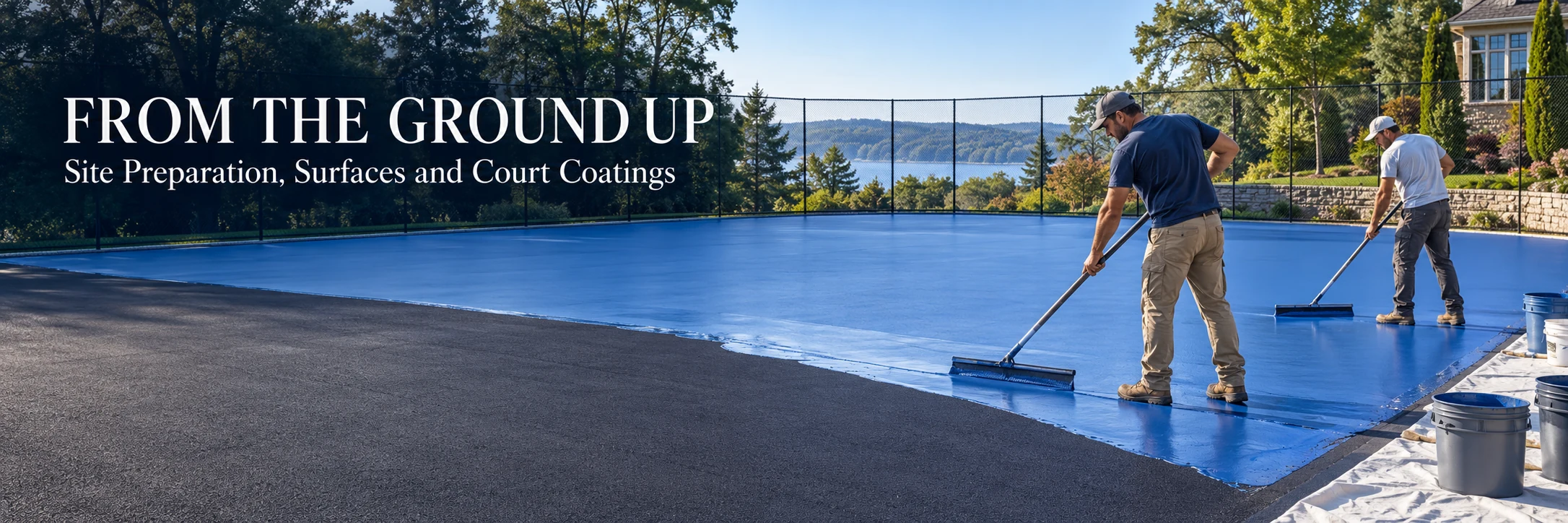
The answer to whether tennis needs special paint is yes. Outdoor hard courts generally use purpose-made acrylic sports coatings rather than house paint, ordinary concrete paint or driveway sealer. The finished system needs a consistent texture, compatible layers and suitable adhesion to a horizontal pavement exposed to sun and water.
SportMaster describes its Neutral Concentrate as a 100 percent acrylic coating formulated for sport surfaces. Its system uses compatible pigment and specified sand additions. Nova Sports likewise publishes multi-layer acrylic specifications incorporating preparation, resurfacer, texture and finish coats. Those manufacturers’ instructions illustrate why a coating system should be purchased as a coordinated set of products. 11 12
The word resurfacer can be confusing. An acrylic resurfacer is a material within the finishing system; it is not a substitute for reconstructing failed pavement. Filling small surface voids and improving uniformity cannot restore a base that is sinking. Ask the contractor to separate structural repairs, crack treatment, levelling and coating work in the proposal.
Silica aggregate affects the texture that shoes and balls encounter. Its grade and quantity must match the manufacturer’s design. Adding arbitrary bags of sand because a court seems slippery can produce uneven playing characteristics. A factory-textured product simplifies one part of mixing, but still requires the specified preparation, water addition and application process.
Court pace should be discussed in terms of the complete surface system. A label such as acrylic, cushioned or blue does not tell you exactly how a court will play. Ask for the proposed product specification and, if possible, play on a comparable installation before approving the finish.
How much coating material does one court need
Begin with the whole area being coated. A 120-by-60-foot enclosure contains 7,200 square feet, or 800 square yards. Two colour coats at a specified yield of 0.05–0.07 US gallon of undiluted concentrate per square yard require a calculated 80–112 gallons. SportMaster publishes that range for its Neutral Concentrate colour-coat application. 11
Those figures apply to that product and application basis. They do not mean every brand needs the same quantity. Ready-to-use material, concentrate, factory-textured coating and an on-site sand mixture have different yields. Diluting concentrate creates more wet mixture but does not increase the amount of acrylic solids purchased.
Tennis Court Supply’s 30-gallon product page gives a planning schedule of approximately 45 gallons for the inner area and 70 gallons for the outer area when applying two coats of its sand-containing colour product. Its instructions separately identify the resurfacer and line materials. The same page recommends confirming quantities against actual surface porosity and texture. 13
Allow for container sizes and colour allocation. If the playing area is blue and the surrounds green, leftover green cannot automatically substitute for blue. Ask the supplier for a written takeoff showing each colour, each coat, all additives and an allowance for the actual condition of the court.
A common purchasing mistake is to compare the price of one five-gallon pail with the price of a complete coating job. The installed job includes preparation, repairs, mixing, application, line setting and labour. Materials alone can still be substantial, but the pail price tells only one part of the story.
Current coating price examples in both countries
For a US retail example, Tennis Court Supply lists its sand-containing colour coating at US$1,102.50 for a 55-gallon drum. Two drums therefore cost US$2,205 before freight and tax. That is a purchasing illustration, not a complete court quotation: a particular project may require additional material, separate colours, resurfacer, repairs and line products. 14
In Canada, DIY Court Canada lists a five-gallon Laykold Advantage factory-textured Silver product at C$180. Its listings also show higher-priced tournament colours. The container size and selected variant must be checked before comparing prices. Twenty five-gallon pails at C$180 would cost C$3,600, but this arithmetic is not a recommendation to use that quantity or to substitute Laykold’s coverage for another manufacturer’s. 15 16
Canadian Shield’s SportMaster catalogue provides another Canadian sourcing route, including ready-mixed colours, resurfacer and line paint. Its displayed price is attached to a specific product and package, so verify the volume and current availability on the selected item. Do not assume that every photograph of a pail represents five US gallons. 17
For installed work, SportMaster publishes approximate guideline prices of US$1.70–2.70 per square foot for a standard three- to four-coat surfacing system. Applied to 7,200 square feet, that calculates to US$12,240–19,440. Preparation and regional conditions still matter. Its cushioned systems have a separate, higher guideline range. 18
A sensible materials order should include the manufacturer’s current technical data sheets and safety information. Buy through a recognised supplier or qualified installer who can confirm substrate compatibility, quantities and storage requirements. The least expensive product is poor value if the full system cannot be completed as specified.
Include line products freight and application equipment
Line marking is a separate purchase from the court’s coloured surface. Tennis Supplies and Equipment describes its Advantage line paint as a specialist court product and gives approximately one gallon as the quantity for a tennis court’s playing lines. The actual order should follow the specified coat count and coverage rather than an assumption that any white paint will do. 46
There are different marking requirements for different surfaces. Hard courts use compatible permanent court-line coatings. Clay commonly uses secured line tapes. Natural grass needs a marking product and procedure suitable for living turf. Nova Sports’ dimensions guidance distinguishes painted hard-court lines from clay tapes. Ask the installer to identify the exact marking system in the quotation. 47
Freight can make a meaningful difference to a materials-only comparison. Ask for the delivered total, not simply the warehouse price. Specify the residential address, vehicle access, unloading requirements and whether delivery has to be coordinated with a contractor. Check whether a freight quotation includes any applicable taxes or import charges.
Read container volumes carefully. Five US gallons is approximately 18.93 litres, not twenty litres. A product sold by the litre, a five-gallon pail and a partially filled container cannot be compared by the word pail alone. Divide price by the actual purchased volume, then consider product yield and all required additions.
Application equipment also belongs in a do-it-yourself budget. Obtain the supplier’s tool list and price mixing equipment, a suitable sports-surfacing squeegee, taping equipment and protective supplies. Ask how leftover material should be stored and how wash water should be managed. A supplier who can provide the coating system but no practical instructions may be the wrong source for a first project.
For US buyers, SportMaster’s SealMaster network and Nova Sports’ installer network provide routes to technical support as well as products. Canadian buyers can seek local support through Canadian Shield, DIY Court Canada or a specialist installer such as West Coast Courts in British Columbia. Confirm the particular brand and service offered rather than assuming every court contractor stocks every coating. 48 49 50
What a clay court is actually built from
Clay describes a family of court systems rather than one standard material. American green clay commonly uses processed crushed stone. Traditional red-clay construction can incorporate a different combination of structural layers, binding material and a red mineral dressing. A red appearance alone does not establish how the surface was built or maintained.
Sport Builders describes one Har-Tru construction method using excavation, grading, a six-inch crushed-stone base, screenings and a final approximately one-inch playing layer. It also describes a different section for natural red clay. These are examples of distinct systems, not instructions to combine their layers. The selected builder should provide the complete approved construction detail. 19
Clay construction must include a dependable water supply and a way of containing the surface material. The perimeter, drainage and irrigation layout belong in the initial quotation. Ask where valves, controls and maintenance equipment will be located, and whether the water pressure is adequate for the proposed irrigation method.
Do not order garden clay, decorative red stone or baseball infield material merely because its colour looks suitable. The supplier needs to confirm tennis-specific grading and compatibility with the entire court section. Transport cost also matters: a new court requires a very different quantity from an annual topdressing order.
For players, clay may justify its care because they prefer the movement and rallies it encourages. That preference should be tested on a well-maintained example of the exact system under consideration. A surface that is too dry, loose or uneven gives a poor basis for deciding whether clay suits your tennis.
Irrigation changes the ownership experience of clay
Traditional overhead watering and subsurface irrigation solve the moisture problem in different ways. Har-Tru’s HydroCourt uses six individually controlled cells and adjustable water levels beneath the surface. The manufacturer describes moisture management through those controls rather than through repeated overhead sprinkling during play. 20
Soft Court Services’ HydroCourt explanation identifies the playing material, compacted screenings, lined cells, panel pipes and control boxes as parts of the system. The liner and associated water control distinguish this construction from an ordinary freely draining aggregate base. Installation details should therefore come from the approved system designer. 21
For an owner, the potential benefit is less interruption and more consistent moisture management. That does not eliminate brushing, inspections, seasonal work or the need to understand the controls. Ask the builder to demonstrate adjustment, explain what symptoms indicate excess moisture and identify who will service valves or damaged irrigation components.
Water use should be considered separately from hands-on maintenance time. An automatic system can reduce the owner’s labour while still consuming water. Request the expected operating approach for your climate and ask whether a separate meter can be installed. Metered use makes future cost comparisons much more useful than guessing from the household bill.
Fast-Dry’s maintenance guidance explains that subsurface-irrigated courts can lose material and change their effective surface profile over time, eventually requiring more substantial levelling work. This is a reason to include a renovation allowance in ownership planning even where routine watering is automated. 22
Where to source clay in the United States and Canada
In the United States, Har-Tru is a starting point for its own surface products and for introductions to experienced builders. Sport Builders provides examples of both Har-Tru and natural red-clay construction. A regional builder who can specify and install the system is usually more useful than buying the playing material first and then looking for someone willing to use it. 19 25
For Canada, Premium Court in Ontario identifies itself as a distributor of Har-Tru clay and coating products. CAT Sports lists Har-Tru green-clay material in 80-pound bags, including pallet options. PC Court in Québec identifies sources for red-clay systems, including North East Fast Dry and Har-Tru American red clay. These are sourcing leads, not a guarantee that every material is in stock or suitable for every construction. 26 27 28
Ask each supplier for a delivered quotation stating material name, grading, bag or bulk quantity, origin, current product documentation and unloading arrangements. A residential address may require liftgate delivery or equipment to handle pallets. Confirm whether freight includes delivery to the court or only to the nearest accessible driveway.
Current compliance documentation is particularly relevant for Canadian green-clay purchases. Québec’s February 2026 public-health notice discusses asbestos concerns involving grey-green court material and continuing precautions. Tennis Canada subsequently reported the product’s return to market following agreed compliance measures and described IGA Stadium’s reopening arrangements. Buyers should request current compliant stock and follow applicable local guidance for dust control and maintenance. These reports do not justify declaring all clay products unsafe or assuming older stock is interchangeable with newly supplied material. 41 42
Natural grass requires a sports turf design
A grass tennis court needs a firm, even playing platform that supports healthy turf and predictable ball behaviour. The design must reconcile root growth, drainage, surface firmness and wear. Installing attractive lawn sod over an uneven garden does not create those conditions.
Wimbledon provides a useful illustration of the attention involved. Its official account describes 100 percent perennial ryegrass, a playing height of eight millimetres and a lengthy establishment and preparation process. Those choices reflect Wimbledon’s climate, soils and playing objectives. They should not become an automatic specification for a private court in Arizona, Ontario or coastal British Columbia. 29 51
Ask a sports-turf specialist to assess the soil profile and drainage before selecting seed or sod. The growing medium beneath delivered sod must be compatible with the receiving rootzone. A combination that impedes water movement can create problems even when both materials are good products individually.
The rootzone for a tennis court should also be designed for tennis. Golf putting-green material is a possible sourcing lead for specialist turf, but a tennis court has different firmness, traction and wear requirements. Ordering a golf product does not establish that its entire construction specification is appropriate for tennis.
Grass places particular importance on how much direct light and air movement the site receives. Discuss nearby trees, winter moisture, irrigation reliability and how long the surface can rest between heavy periods of use. Ask what the specialist would decline to build on the property, as well as what they are willing to sell.
Finding suitable grass in the United States
For a US natural-turf enquiry, West Coast Turf and Western Sod offer a range of specialist grasses in California and Arizona, including sports and golf applications. Their catalogue is a route to discussing suitable varieties and growing media with a professional. It is not evidence that every listed variety is appropriate for low-cut tennis. 32
The question to ask is more precise than whether a company sells sod. Explain the location, planned mowing height, intended playing season, rootzone design and expected frequency of use. Ask whether the producer has supplied comparable tennis installations or can work with the consultant responsible for the agronomic specification.
Grass shipped a long distance needs coordinated harvesting, transport and installation. The court base and irrigation should be ready before the delivery date is booked. A pallet left waiting because a contractor has not finished grading can turn an efficient purchase into a time-sensitive rescue job.
Seed may be a sensible alternative where the programme allows establishment time. It can also provide access to a specified cultivar that is not available as local sod. The choice should follow the growing conditions and maintenance plan. Ask the turf specialist to distinguish the date the surface looks green from the date it is sufficiently rooted and firm for tennis.
Finding suitable grass in Canada
Canadian owners have specialist suppliers close enough to investigate directly. Bos Sod Farms in Abbotsford, British Columbia, offers bentgrass greens sod and custom-growing services. Its website identifies varieties and growing-medium options, and notes that custom orders can require approximately twelve months’ notice. That lead time belongs in the project schedule before construction starts. 30
Western Turf Farms, with farms in Langley and Abbotsford, identifies sports-field and golf-course turf among its offerings and lists bentgrass sod. It is another practical enquiry point for an owner in Western Canada. Owners elsewhere should ask a regional sports-turf consultant which producer can meet the required specification and delivery programme. 31
Western Turf’s published BC pricing guide illustrates the difference between ordinary lawn sod and specialist turf: it lists commercial bentgrass from approximately C$1.50 per square foot for pickup and C$2 delivered. At C$2 across 7,200 square feet, the calculated sod cost alone would be C$14,400 before site work and installation. This is an illustration using the advertised starting figure, not a tennis-court sod quotation. 33
The playing surface is only part of the grass investment. Allow separately for rootzone construction, drainage, irrigation, establishment and the equipment required to maintain the approved mowing height. A cheap sod price cannot compensate for the absence of a person capable of maintaining the finished court.
Compare maintenance time before comparing annual bills
Owners often ask which surface is cheapest to maintain without first deciding who will do the work. A court maintained by its owner has a different cash budget from one serviced by a contractor. The hours still exist even when they do not generate an invoice.
The following is an editorial workload model for a private court used through a roughly 26-week season. It is not a measured industry average. It assumes routine care by a competent person, excludes exceptional storm damage and recognises that longer seasons increase the workload. Use it to ask for a site-specific service proposal.
| Surface | Example routine workload during the season | Additional work to allow for |
|---|---|---|
| Acrylic hard court | About 30–60 minutes weekly | Cleaning visits, inspection and minor repairs |
| Clay with overhead irrigation | About 20–40 minutes on days needing care | Opening, closing, material replacement and occasional repair |
| Subsurface-irrigated clay | Often less watering labour, with brushing and checks still required | System servicing and periodic surface restoration |
| Natural grass | About 4–8 hours weekly as a preliminary allowance | Seasonal renovation, equipment care and recovery from wear |
Har-Tru identifies brushing, watering and rolling as the main recurring clay tasks, with rolling particularly relevant after freeze–thaw conditions. Wimbledon and the Queen’s Club accounts demonstrate the frequency of mowing, marking, moisture management and renovation on intensively maintained grass. These sources support the type of work; they do not establish the private-owner hours in the table. 23 29 34
Before choosing a surface, obtain a written maintenance calendar. Ask which tasks continue when nobody plays for a week. For grass and clay, the answer may be more consequential than the number of matches the family expects to play.
What to budget each year for maintenance
A useful annual budget separates consumables and services, water, labour, lighting electricity and future renewal. Combining everything into a single vague maintenance allowance makes it difficult to see what is missing. The following model uses US dollars and deliberately states the assumptions rather than presenting them as national averages.
| Cost component | Hard court model | Clay model | Grass model |
|---|---|---|---|
| Routine materials and minor service allowance | US$750 | US$1,500 | US$2,000 |
| Annual hands-on labour assumption | 40 hours | 150 hours | 250 hours |
| Labour valued at US$35 per hour | US$1,400 | US$5,250 | US$8,750 |
| Annual renewal reserve assumption | US$2,500 | US$1,000 | US$1,500 |
| Illustrative annual total before water and lights | US$4,650 | US$7,750 | US$12,250 |
If the owner supplies all labour, the immediate cash totals in this model fall to US$3,250, US$2,500 and US$3,500 respectively. That does not make the hours disappear. The renewal reserve is money set aside rather than necessarily spent during that year, and the minor-service allowance must not duplicate work already counted as labour.
For a Canadian version, replace the materials and service allowances with local quotations and use the actual hourly charge. As an arithmetic example, 150 hours at C$45 costs C$6,750 in labour alone. Applying the illustrative 1.40 currency factor to the US totals would produce C$6,510, C$10,850 and C$17,150, but those are converted scenarios, not Canadian market estimates.
Water is deliberately separate because a household’s tariff, rainfall, irrigation design and playing season can change it greatly. Measure consumption rather than assign every clay or grass court the same annual water bill.
Put water use into the maintenance calculation
An irrigation estimate becomes more useful when it states a volume. One millimetre of water spread across one square metre equals one litre. For a rounded 669-square-metre court envelope, an illustrative five millimetres represents 3,345 litres, or 3.345 cubic metres. This is a mathematical example only, not a watering recommendation for grass, clay or any particular irrigation system.
Suppose that example volume were used once weekly for 26 weeks, with no other water use counted. The annual amount would be 86.97 cubic metres. At an assumed combined water and applicable wastewater charge of C$4 per cubic metre, the calculated cost would be C$347.88. Your actual local charging structure may treat outdoor irrigation differently, so check the bill rather than applying this rate automatically.
The same volume is approximately 22,975 US gallons over the season. At an assumed US$10 per thousand gallons, it would cost approximately US$230. Both examples describe the same hypothetical amount of water. They are not estimates of what a real court needs or comparisons of national utility tariffs.
Rainfall, evaporation, leaks, irrigation distribution and the surface system change the volume that must be purchased. A weather-responsive controller does not remove the need to check whether water reaches the intended area. Ask the maintainer to keep an initial log of settings, rainfall and observed court conditions so adjustments are based on experience at the property.
Where the water supply is constrained, discuss that limitation before selecting the court. Determine whether storage, pressure improvements or additional plumbing would be required and price them separately. A proposed surface should fit the reliable supply available throughout the intended playing season, including periods when the household also needs water for other purposes.
During commissioning, request a demonstration rather than accepting a verbal assurance that the irrigation is automatic. Learn where the shutoff is, how the system indicates a fault and what should happen after prolonged rain. Record the contact details for servicing. This makes the water system part of normal property management and reduces the chance that a small unnoticed problem becomes an expensive interruption to play.
Looking after an acrylic hard court
Hard courts usually demand less daily intervention than clay or closely managed grass, but they benefit from routine attention. Remove leaves and debris, check drains and inspect the surface after unusual weather. Arrange repairs while a problem is small enough to evaluate clearly.
SportMaster’s maintenance guidance recommends regular cleaning and an annual inspection addressing surface condition, drainage, cracks, low spots and equipment. It describes resurfacing as specialist work rather than a task to improvise with unrelated repair materials. Ask the original installer for a maintenance procedure that suits the particular coating. 39
Washing deserves care. The manufacturer’s best-practice guidance recommends soft cleaning equipment and cautions about excessive pressure. A contractor preparing a damaged surface for renovation may use a different process from the owner performing routine cleaning. Do not assume that an aggressive pressure-washer setting is appropriate because it removes dirt quickly. 43
For long-term planning, SportMaster’s resurfacing FAQ quotes approximately US$12,000–20,000 and describes a four- to eight-year cycle depending on use and maintenance. A US$15,000 job divided over six years produces the US$2,500 annual reserve used in the model above. Extensive repairs or reconstruction fall outside that simple example. 40
The most useful maintenance record is brief and consistent. Keep the installation specification, repair invoices and photographs showing changes. When a crack returns, the repair history helps a specialist decide whether another local treatment is reasonable or whether the underlying cause needs investigation.
Looking after a clay court
Clay care centres on keeping the playing material appropriately distributed, compacted and moist. The work changes with weather and use. A dry windy day, a prolonged wet spell and a newly reopened spring court do not call for an identical routine.
Follow the surface manufacturer’s brushing and moisture instructions. Har-Tru explains that brushing redistributes the dressing but can also dry the surface, and that rolling depends on the condition of the court. The owner needs instruction in recognising when work is helpful and when the surface should be left alone. 23
Seasonal opening can be a substantial operation. Cambridge Tennis Club in Ontario describes removing debris, scarifying, adding material, rolling, watering and resetting lines across its courts. Its club-scale example is useful evidence that annual clay preparation involves more than turning on a sprinkler, although its staffing and expenditure cannot be applied directly to a single private court. 24
Ask a prospective maintenance contractor to quote spring preparation separately from routine visits. Establish who supplies replacement material, who checks the irrigation and how urgent problems are handled. A complete service arrangement should also explain what happens while the owner is travelling.
If dust-control or material-handling guidance applies to the product supplied, incorporate it into the maintenance agreement. Ask for current instructions instead of relying on practices remembered from a different club or an older installation. Material choice, maintenance procedures and staff training need to work together.
Looking after a natural grass court
Grass maintenance combines mowing, marking, irrigation decisions and turf management with the demands of tennis. Foot traffic is concentrated in predictable places, especially around the baselines. A court can remain visually attractive around the perimeter while its most heavily used areas need renovation or rest.
The LTA’s interview with the Queen’s Club head groundsman describes regular monitoring of moisture and hardness alongside mowing, rolling and marking. That professional example illustrates the skill involved in preparing grass for consistent play. It does not imply that a homeowner must reproduce tournament staffing levels. 34
Ask your specialist to specify a mower capable of the required height and quality of cut, along with its servicing needs. A standard rotary lawn mower may not provide the finish intended by the court design. Include equipment storage, cleaning and a practical route onto the court in the ownership plan.
Grass also needs a policy for unsuitable playing conditions. Wet or vulnerable turf can be damaged by use at the wrong time. The maintainer should explain when the court must close and how that decision will be communicated to family and guests.
Budget for renovation and the time needed for recovery. If your family expects unrestricted daily play throughout the season, discuss whether one natural grass court can meet that demand. The attractive purchase becomes less useful if its maintenance requirements conflict with the owner’s actual tennis habits.
How much tennis court lighting costs to install
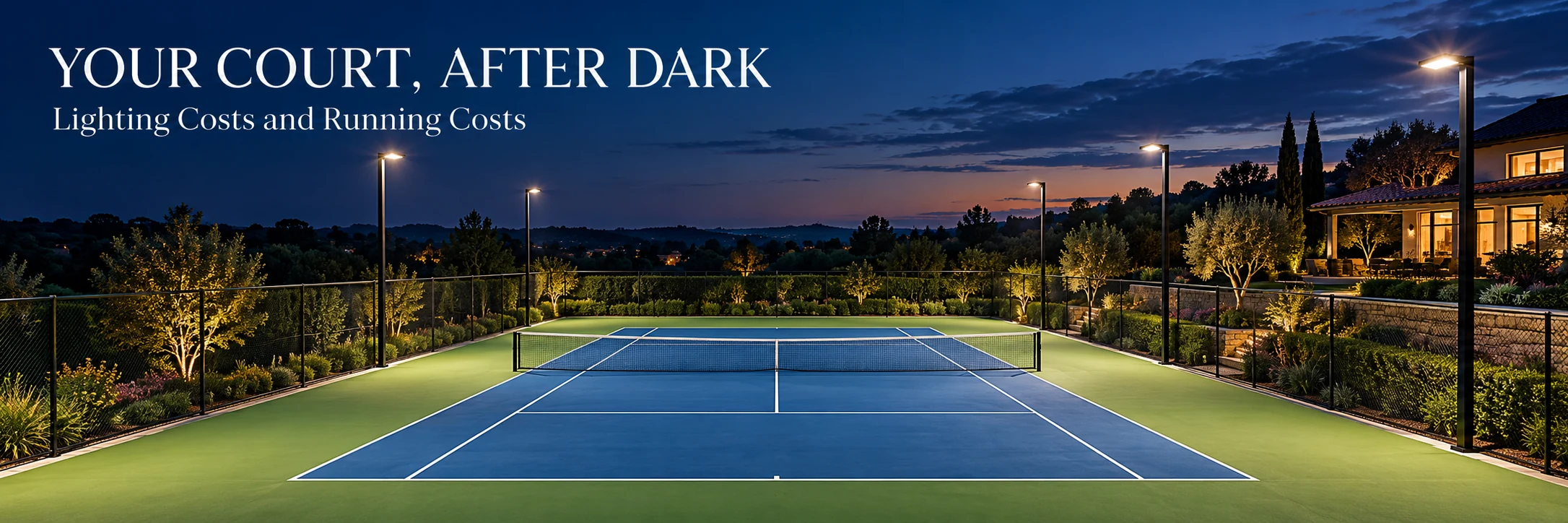
Lighting is a separate construction project involving fixtures, poles, foundations, wiring, controls and a suitable electrical supply. FSG publishes a broad US$20,000–80,000 range for complete LED court-lighting projects. CrowAll’s Ontario guide gives approximately C$15,000–40,000 for lighting additions. These figures represent different suppliers and scopes, so the Canadian example should not be interpreted as a currency-adjusted equivalent of the American range. 35 3
A retail equipment example helps explain the difference. LED Spot lists a recreational package with six poles and six 300-watt LED fixtures at US$17,898. Purchasing that package does not establish the cost of excavating foundations, installing electrical infrastructure or obtaining a completed, approved installation on your property. 36
The light needs to make the ball visible during serves, overheads and lobs, as well as near the ground. The ITF facilities guidance addresses illumination, uniformity and glare, and explains that competent lighting professionals should design the installation. Ask for a photometric plan showing the proposed performance across the playing area and its surroundings. 37
For a private owner, the most revealing question is what the installation will look like from both baselines and from neighbouring property. A powerful light pointed in the wrong direction can be unpleasant even if its advertised lumen output is impressive. Have the designer explain glare control, spill light and permitted operating hours before ordering poles.
Arrange underground conduits and electrical provisions while other site work is being planned. If lighting will be added later, ask what can be sensibly installed now without committing to an unapproved final design. Confirm that the future fixtures, supply and controls remain compatible with that preparatory work.
Calculate electricity from watts and actual playing hours
The operating calculation is straightforward: total system watts divided by 1,000 gives kilowatts. Multiply kilowatts by operating hours to obtain kilowatt-hours, then multiply by the applicable electricity price. Use the rated input power for the complete installation rather than a marketing comparison with an older lamp.
Six fixtures drawing 300 watts each use 1.8 kilowatts. At an illustrative electricity rate of 15 cents per kilowatt-hour, they cost 27 cents per hour to operate. Three hours costs 81 cents. These are energy-only calculations in the currency of the tariff, not a claim that US and Canadian electricity have the same price. 36
For a full-year example of three evenings weekly at three hours each, the lights operate for 468 hours. The 1.8-kilowatt system consumes 842.4 kilowatt-hours. At US$0.15 per kilowatt-hour that is US$126.36; at C$0.15 it is C$126.36. A 26-week season at the same playing frequency halves both energy use and cost.
| Electricity rate in the bill currency | Hourly cost at 1.8 kW | Annual energy cost at 468 hours |
|---|---|---|
| 0.10 per kWh | 0.18 | 84.24 |
| 0.15 per kWh | 0.27 | 126.36 |
| 0.25 per kWh | 0.45 | 210.60 |
| 0.40 per kWh | 0.72 | 336.96 |
Your bill may include delivery charges, time-of-use rates or other adjustments. Use the incremental rate applicable when the lights operate. Fixed household charges already payable without the court should not automatically be assigned entirely to tennis. Add separate allowances for inspections, cleaning, repairs and eventual replacement of lighting components.
Energy savings do not tell the whole lighting story
LED manufacturers can legitimately describe substantial energy reductions compared with older discharge lighting, but an owner needs the actual proposed wattages. LSI’s ZONE sports-lighting information describes reductions of up to 75 percent against typical HID court systems. The phrase up to matters: it is not a guaranteed saving for every installation. 38
Consider an expressly hypothetical comparison between eight older fixtures drawing 1,000 watts each and eight proposed fixtures drawing 300 watts each. The difference is 5.6 kilowatts. At 468 hours annually and US$0.15 per kilowatt-hour, the calculated annual energy saving is US$393.12. Whether the new design provides equivalent useful lighting requires a separate assessment.
At that saving, a US$20,000 retrofit would take roughly 51 years to repay through electricity alone. This simple calculation excludes maintenance savings, incentives, financing and changes in use. It shows why a lightly used private court should not adopt a commercial facility’s payback claim without checking the hours.
An owner may still reasonably value improved visibility, reliable switching and replacing deteriorated equipment. Those benefits should be stated honestly. Ask the installer for an operating-cost worksheet based on your expected use and a separate explanation of any maintenance savings assumed.
How long construction takes
Separate the project into permission and design, procurement, physical construction and readiness for play. A contractor’s statement that a court takes several weeks may refer only to work after the site and approvals are ready. It may exclude the time needed to secure specialist equipment or establish turf.
The following ranges are editorial scheduling allowances for discussion with a contractor, not promised completion times. Weather, local approvals, difficult excavation and equipment availability can extend them substantially. Some activities overlap, while others must occur in sequence.
| Stage or surface | Preliminary planning allowance | What can extend it |
|---|---|---|
| Design approvals and procurement | Several weeks to several months | Surveys, local review, specialist materials and contractor availability |
| Asphalt court after a prepared programme is agreed | Roughly 6–12 weeks including coating readiness | Earthwork, rainfall, curing and suitable coating weather |
| Clay installation | Roughly 4–10 weeks after approvals and procurement | Drainage, irrigation, material delivery and surface commissioning |
| Natural grass construction | Earthwork and installation measured in weeks | Rootzone work, irrigation and suitable growing conditions |
| Natural grass readiness for sustained tennis | Potentially several months or a full growing season and longer | Establishment method, cultivar, weather, rooting and acceptance standard |
Manufacturer curing requirements explain part of the hard-court timetable. SportMaster’s best-practice guidance recommends approximately 30 days for new asphalt under suitable conditions and 28 days for concrete before coating. A particular product specification may differ, and the installer should confirm the applicable requirement rather than use the shortest number found elsewhere. 43
Grass has an additional biological timetable. Wimbledon describes approximately fifteen months to prepare a Championships-standard court. Bos Sod’s golf-sod guidance discusses shorter establishment periods under favourable growth, but that is not a guaranteed tennis opening date. The appropriate lesson is to specify acceptance conditions, not to promise that all grass courts can open on either timetable. 29 44
Painting and curing need suitable weather
A court can look ready for colour and still need to wait. Nova Sports’ acrylic-finish guidance calls for suitable temperatures, a dry prepared substrate and appropriate weather. It also describes checking depressions before coating and applying compatible line material. A rushed finish can jeopardise work that took weeks to prepare. 45
The owner should ask how the contractor will handle rain, cool nights and a delayed paving programme. A coating date written into a calendar is less useful than an agreed process for confirming that conditions are suitable. The contractor should also distinguish drying between coats from the final period before play resumes.
Do not schedule a large opening event around an assumed curing date. Keep footwear, furniture, pets and maintenance equipment off the new finish until the installer releases it for use. Obtain cleaning and storage instructions for any leftover material before the crew leaves.
This is also the right time to confirm the completed line layout and net installation. Have discrepancies corrected through the contractor rather than adding unrelated paint yourself. Keep the final colour names and product records so future work can be specified from something more reliable than a faded photograph.
Build a complete project budget rather than a surface budget
The following comparison is an editorial example of how to organise a quotation. Every number is an assumption, not a supplier offer or national average. The hypothetical court contracts include their designed bases, finished surfaces, standard fencing and net equipment, while the additional site allowance covers work expressly excluded from those contracts.
| Assumed project component in US dollars | Hard court | Clay | Natural grass |
|---|---|---|---|
| Court construction package | 70,000 | 80,000 | 90,000 |
| Additional site work allowance | 20,000 | 20,000 | 20,000 |
| Complete lighting allowance | 30,000 | 30,000 | 30,000 |
| Professional fees and surrounding restoration | 10,000 | 10,000 | 10,000 |
| Subtotal | 130,000 | 140,000 | 150,000 |
| Illustrative contingency at 15 percent | 19,500 | 21,000 | 22,500 |
| Planning total | 149,500 | 161,000 | 172,500 |
This example deliberately illustrates a more complete project than a low advertised court price. It excludes land, taxes, financing and exceptional works. Specialist maintenance equipment, such as a suitable grass mower or clay roller, must be added if it is not provided through a service arrangement.
Use the same categories when comparing local Canadian bids. Do not paste these US assumptions into a Canadian contract. Identify which site works are already included so they are not counted twice. A contingency covers uncertainty; it does not make an incomplete scope complete.
Look at ownership over fifteen years
Combining the illustrative construction totals with the earlier annual model provides a transparent ownership comparison. With all labour valued, fifteen years of the assumed annual budgets produces US$69,750 for hard court, US$116,250 for clay and US$183,750 for grass. Adding construction gives US$219,250, US$277,250 and US$356,250 respectively.
These are simple undiscounted scenarios in constant dollars. They exclude water, lighting energy, taxes, financing, inflation and residual property value. Because annual renewal reserves are already included, adding the same resurfacing expenditure again would double count it. Actual repair timing can still require a larger cash payment in a particular year.
The result should not be treated as a ranking that applies to every property. It mainly shows how paid labour can influence the long-term comparison. Owners who enjoy maintaining a clay or grass court may accept that commitment. Owners seeking only convenient access to tennis should put a realistic value on time they would rather spend playing.
Choose the surface around your tennis
Before committing, describe an ordinary week of tennis at the property. How many people will play, at what times, and who will prepare the court? A family using the court spontaneously needs a different ownership arrangement from someone who enjoys planning sessions around a carefully maintained surface.
Visit completed installations that resemble your project. Ask owners about the maintenance they actually perform, the work they outsource and the interruptions they did not anticipate. Their experience will be most useful when climate, usage and site conditions resemble yours. An exceptional show court may offer little guidance about an ordinary residential maintenance budget.
Ask yourself which compromise you would accept most readily. You may prefer a simpler routine, the experience of playing on clay, or the particular enjoyment of natural grass. Establish that preference before comparing decorative finishes or accessories. Money spent on a surface you seldom use will be difficult to justify, even if its construction price was competitive.
Finally, budget a first season as a learning period. Review actual maintenance hours, utility use and the times when the court was unavailable. Those records will improve the next annual budget and help the maintainer adjust the service arrangement to the court and its owners.
Questions to put into the written quotation
Ask the builder to identify the full dimensions, the designed construction section and the standard used for acceptance. The proposal should explain site preparation, drainage, material quantities, utilities and all exclusions. Require a process for approving additional work before it is undertaken.
For coatings, request product names, coat counts, colour allocation, texture and preparation requirements. For clay, request the complete surface system, irrigation design, delivered material documentation and maintenance training. For grass, request the rootzone specification, cultivar, establishment plan and criteria for opening the court.
For lighting, ask for a photometric plan, total input power, foundations, electrical scope and controls. Confirm who obtains approvals and who coordinates the court, fencing and electrical contractors. Ask what the warranty covers and which maintenance obligations affect it.
Finally, request a handover visit with operating instructions and a first-year service proposal. Choose the court you will enjoy using and can reliably care for. The strongest investment is a well-built surface whose continuing demands fit the people who own it. Confirm these expectations before signing the contract.
Editorial method and scope
Published prices were researched in October 2026 and are examples, not binding quotations. Workload tables, ownership budgets, the exchange factor and utility rates are illustrative editorial assumptions, not measured national averages. This guide is planning information, not a property-specific engineering, electrical or agronomic specification. Supplier mentions are informational. Banner images are AI-generated illustrations.
Sources
- [1] HomeGuide tennis court construction cost guide — US price references dated October 31 2025
- [2] Fast Dry Courts frequently asked construction questions — South Florida ballpark prices and explicit site work exclusions
- [3] CrowAll cost to build a tennis court in 2026 — Ontario contractor construction and lighting examples
- [4] Tennis Canada municipal tennis facilities framework — Historical 2019 framework rather than a current residential quotation
- [5] ITF court dimensions and organisational requirements — Playing dimensions and surrounding clearances
- [6] Nova Sports construction guidance on court orientation — Published guidance to discuss with the project designer
- [7] Nova Sports construction guidance on site investigation — Subsoil groundwater and frost considerations
- [8] Nova Sports site preparation earthwork and subbase guidance — Earthwork and compaction principles
- [9] Nova Sports surface and subsurface drainage guidance — Water collection conveyance and discharge
- [10] Nova Sports hot mix asphalt tennis court guidance — Published asphalt court slope guidance
- [11] SportMaster ColorPlus Neutral Concentrate technical information — Product composition coverage mixing and application
- [12] Nova Sports four coat acrylic finish specification for concrete — Example of a coordinated coating system
- [13] Tennis Court Supply colour with sand in a 30 gallon keg — Product quantities and application instructions
- [14] Tennis Court Supply colour with sand in a 55 gallon drum — US retail price example
- [15] DIY Court Canada Laykold Advantage Silver coating — Selected five gallon variant and Canadian price
- [16] DIY Court Canada factory textured Laykold colours — Colour selection and different advertised starting prices
- [17] Canadian Shield SportMaster sport surfaces catalogue — Canadian coatings resurfacer and line product sourcing
- [18] SportMaster architect specifications and installed cost guidelines — Standard and cushioned acrylic system price guidelines
- [19] Sport Builders Har Tru and natural clay court construction — Examples of complete clay court construction systems
- [20] Har Tru HydroCourt system overview — Six controlled subsurface irrigation cells
- [21] Soft Court Services HydroCourt construction explanation — System layers and water control
- [22] Fast Dry Courts maintenance guides — Long term surface profile and renovation needs
- [23] Har Tru clay court maintenance — Brushing watering rolling and seasonal conditions
- [24] Cambridge Tennis Club court servicing and maintenance — Ontario club example of seasonal clay court preparation
- [25] Har Tru company and builder information — Surface products and independent builder network
- [26] Premium Court Canadian Har Tru distribution and construction — Ontario sourcing lead
- [27] CAT Sports Har Tru green clay in 80 pound bags — Canadian material sourcing lead subject to documentation and availability
- [28] PC Court surfaces and red clay sourcing — Quebec supplier descriptions and red clay sources
- [29] Wimbledon grass courts and maintenance — Playing height maintenance and championship establishment timetable
- [30] Bos Sod bentgrass greens sod and custom growing — Abbotsford specialist turf enquiry and custom growing lead time
- [31] Western Turf Farms specialist sod catalogue — British Columbia sports and golf turf sourcing lead
- [32] West Coast Turf and Western Sod — US specialist turf enquiry rather than an automatic tennis specification
- [33] Western Turf Farms BC sod pricing guide — Advertised commercial bentgrass starting price illustration
- [34] LTA interview with the Queens Club head groundsman — Professional grass court maintenance processes
- [35] FSG tennis court lighting installation and costs — US complete lighting project cost range
- [36] LED Spot recreational six pole six fixture court kit — US equipment package price and six 300 watt fixtures
- [37] ITF facilities guide outdoor lighting recommendations — Illumination uniformity glare and specialist design
- [38] LSI ZONE sports and court lighting — Manufacturer comparison with typical HID energy use
- [39] SportMaster tennis court maintenance — Routine care inspection and repair
- [40] SportMaster tennis court resurfacing cost FAQ — Published installed cost and resurfacing intervals
- [41] Quebec public health notice on certain clay court materials — February 6 2026 update and precautions
- [42] Tennis Canada update on reopening clay courts at IGA Stadium — 2026 compliance monitoring market availability and operating measures
- [43] SportMaster resurfacing best practices — Curing weather and cleaning considerations
- [44] Bos Sod golf course sod frequently asked questions — Growing media and conditional establishment times for golf sod
- [45] Nova Sports acrylic colour finish guidance — Preparation application and playing lines
- [46] Tennis Supplies and Equipment Advantage court line paint — Court line product and approximate quantity
- [47] Nova Sports court dimensions and line materials — Court measurement and surface specific line systems
- [48] SportMaster nationwide SealMaster distribution network — US product sourcing and support
- [49] Nova Sports court construction resources and installer links — Manufacturer construction resources and installer network
- [50] West Coast Courts construction and resurfacing services — British Columbia installer enquiry
- [51] LTA Wimbledon Championships information — Perennial ryegrass surface identification
Comments
No comments yet.