
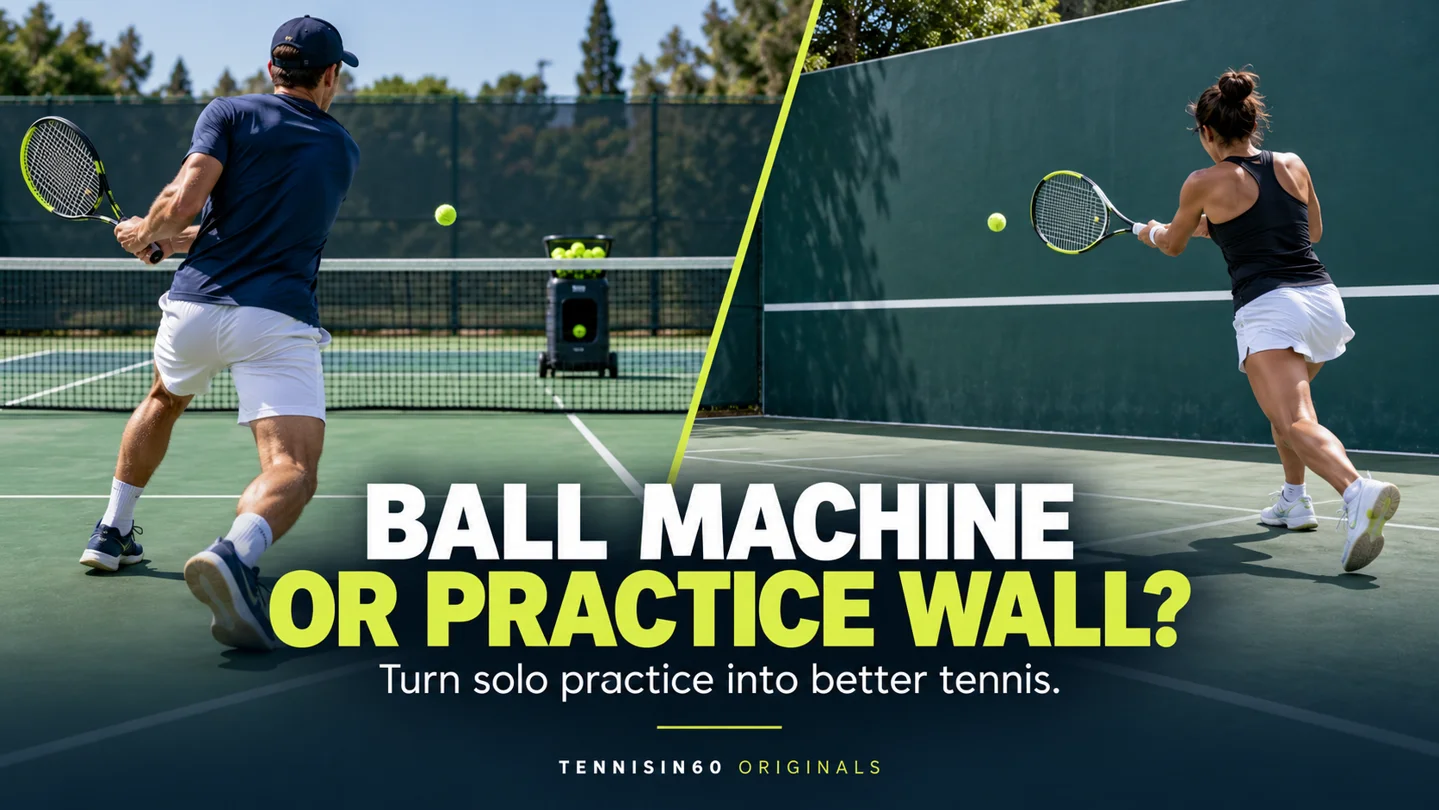
Yes—a ball machine and a practice wall can both be useful ways to work on your tennis. They provide opportunities to repeat a task without arranging a hitting partner. The benefit depends on what you practise, how you check it and whether you can use the skill against an opponent.
Neither tool guarantees improvement, and counting balls hit is a poor substitute for checking the quality of the task. A productive solo session should have a purpose you can explain in one sentence: today I am creating better space on my backhand, or today I am controlling the first volley toward a generous target.
The drills below are suggested coaching formats. Adjust the pace, duration and difficulty to your level, equipment, available space and usual playing load.
What a ball machine does well
A machine lets you arrange repeatable incoming balls. You can work on a particular contact height, movement pattern or landing area and change the settings as the task develops. Practising over a real net into a court also lets you check whether the ball lands inside your intended target.
This is particularly useful after a lesson. Instead of spending the next session trying several unrelated changes, use the agreed feed and one familiar cue. The machine supplies the ball; your job is to organise the movement and produce the intended response.
In USTA coaching guidance, Dave Colby includes a ball machine or backboard among the options for controlled practice when making a technical change. He emphasises progressing patiently rather than expecting a change to become reliable after a few lessons. [1]
Where a machine can mislead you
A fixed feed can make you look unusually fluent. You know where the next ball is coming from and may already be standing in the ideal place. The task becomes less revealing if you stop recovering after each shot or quietly ignore the misses while remembering your best contacts.
Machines also differ. Some offer changing direction, spin and sequences; others supply a much simpler feed. Even a sophisticated sequence is not the same as reading an opponent’s preparation and deciding what their next shot means.
A standard machine feed is not a complete test of returning serve either. It does not reproduce a server’s toss, action and all the visual information you use to prepare. If return performance is the goal, include returns against a person as part of the assessment.
A purposeful 30-minute machine session
This sample divides a short booking into tasks, with pauses for rest, adjustment and ball collection. Spend more time on the warm-up if you need it, and shorten the hitting blocks when quality drops. Follow the manufacturer’s operating instructions and pause the machine before collecting balls or changing its position.
| Block | Suggested use | What to check |
|---|---|---|
| First 5 minutes | Warm up with comfortable feeds and generous targets | Are you arriving with enough space and control? |
| Next 8 minutes | Work on one agreed stroke or contact situation | Record a small sample instead of judging the whole session by feel |
| Next 7 minutes | Add recovery and a change in incoming placement | Can you repeat the task after moving? |
| Next 5 minutes | Use a short pattern with a defined target | Does the shot remain useful when the sequence changes? |
| Final 5 minutes | Recheck the task and write down one observation | What should you test with a partner next? |
Drill: a target and a recovery position
Set a manageable feed toward your backhand. Choose a generous landing area inside the opposite court and a recovery position appropriate to the drill. Hit a short block, recover after each ball and record how many shots land in the target.
If you are consistently successful with good spacing, change one feature: the placement, the amount of movement or the target. If the exercise falls apart, simplify it. Increasing speed and shrinking the target at the same time makes it harder to identify the problem.
Drill: recognise the shorter ball
Where the machine allows it, mix a neutral-depth feed with a shorter one. Use the neutral ball to establish the rally and decide whether the short ball genuinely gives you an opportunity to move forward. A short ball that arrives low or leaves you stretched may call for a different response from a comfortable ball above net height.
If your machine cannot vary the feed, practise the two situations separately first. Then ask a partner or coach to mix them. The important progression is from knowing the task in advance to making a decision from the ball you actually receive.
What hitting against a wall does well
A wall offers a simple way to practise racket-and-ball coordination, repeated contacts and preparation. It can be especially useful when court access, money or a partner is the limiting factor. The LTA’s solo-training guide describes using a wall for groundstrokes, volleys and different practice patterns. [2]
You can choose a particular side, alternate forehands and backhands or practise a compact volley action at a manageable pace. Because you create the outgoing ball, the next rebound also gives immediate information about how controllable that ball was.
The target should be useful repetition, not merely surviving the fastest rebound you can create. Choose a suitable practice wall and clear space where hitting is permitted. A softer or lower-compression ball may make the exercise more manageable, depending on the surface and the player.
What a wall cannot tell you
Hitting a mark on a wall does not prove that the same shot would clear a net and land inside the opposite baseline. You do not see the full court flight, and the rebound behaves differently from an opponent’s return. Wall distance, surface and ball type all influence the rhythm.
If you stand so close that every ball rushes you, you may end up rehearsing an emergency response rather than the stroke you intended to practise. Move to a more manageable position, reduce pace or allow an extra bounce for the exercise. A two-bounce practice format is a training adaptation, not normal match play.
Avoid treating the rebound as a perfect coach. It shows an outcome, but it cannot tell you whether your grip, balance or movement is suitable for your game. Occasional feedback from a qualified coach can help you decide what to keep repeating.
Three useful wall drills
The LTA’s at-home practice guidance suggests marking a net and targets on a wall and alternating strokes. [3] Use removable markings only where permitted, and adapt the following examples to the available space.
1. One-side control
Choose a broad wall target and work on one groundstroke. Start with a modest aim, such as five controlled contacts while keeping useful spacing. Reset whenever the ball forces you into a different task. Record the number of clean sequences rather than counting every scrambling touch as success.
2. Alternate and prepare
Alternate forehand and backhand at a comfortable pace. Pay attention to preparing for the next rebound instead of watching your previous shot. Stop after a short sequence, reset your feet and begin again. Make the rhythm easier before making it faster.
3. Volley control
From a suitable distance, use gentle volleys aimed at a generous area. Keep enough room to react safely and avoid trying to win a speed contest with the wall. The purpose is to control contact and direction. Later, test the volley on court against balls arriving from a partner at different heights.
Which should you choose?
| Training need | Ball machine | Practice wall |
|---|---|---|
| Check shot depth on a court | Lets you observe net clearance and landing | Does not show the full shot into an opposite court |
| Repeat a particular incoming ball | Useful when settings suit the task | Rebound depends heavily on your previous shot |
| Practise without a partner | Requires access to a machine and suitable space | Can be accessible where an approved wall is available |
| Work on preparation and repeated contact | Useful with a suitable feed and recovery task | Useful with a manageable rebound and clear target |
| Read an opponent and play points | Needs a separate live-play test | Needs a separate live-play test |
You do not need to buy a machine to find out whether machine practice suits you. If access is available, try a club booking with a clear task first. A wall may already solve your problem if you primarily need a convenient way to repeat controlled contacts between lessons.
Connect solo work to a real point
End the week with a test that resembles the reason you trained. After backhand practice, ask a partner to vary placement during live rallies. After volley work, practise approaching and playing out the point. After work on depth, check whether the rally ball gives your opponent a more difficult next shot.
Use comparable samples. Record target hits out of attempts during solo practice, then note whether the skill appears in an appropriate live situation. Better machine scores are encouraging; they do not by themselves demonstrate better match results.
For weekly scheduling, see [How Often Should You Play Tennis to Improve?](/news/how-often-should-you-play-tennis-to-improve). If your strokes feel good in drills but disappear under a score, read [Why You Play Better in Practice Than in Matches—and How to Change It](/news/why-you-play-better-in-practice-than-in-matches).
Make the tool serve the task
A machine gives you controllable feeds. A wall gives you an accessible rebound. A coach offers feedback, and an opponent adds the decisions and consequences of playing points. Each has a useful job.
Choose one task, practise it at a manageable difficulty and check what transfers to the court. That is a more useful measure of solo training than how many balls were left in the basket or how long you kept the wall rally alive.
Comments
No comments yet.