

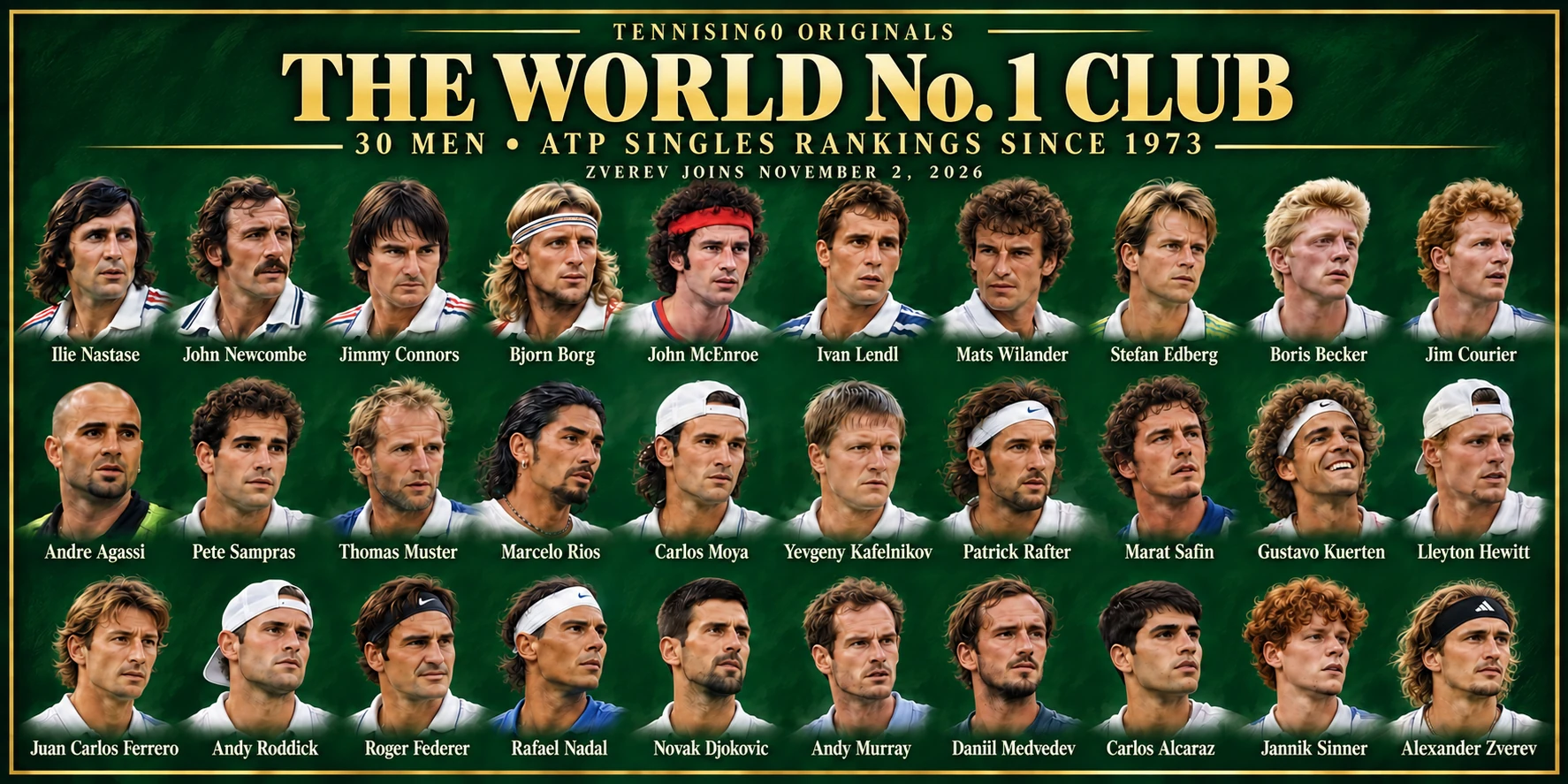
Winning a Grand Slam means being the best player across one extraordinary fortnight. Becoming world No. 1 usually demands something broader: enough success across the ranking period to stand above everyone else.
The official ATP singles rankings began on August 23, 1973. This history follows those rankings, rather than earlier newspaper or expert assessments. Dates identify each player’s first official appearance at No. 1, which can come after the match that secured the position. As of publication on October 29, 2026, Zverev has secured his accession for November 2; his ranking has not yet taken effect.
1. Ilie Năstase — August 23, 1973
Romania · The gifted Romanian became the first ATP computer-ranked No. 1 when the system launched. He already held the 1972 US Open title and had won Roland-Garros in 1973 without dropping a set. Unlike his successors, he did not displace an existing ATP No. 1: he established the position. [1]
2. John Newcombe — June 3, 1974
Australia · An accomplished serve-and-volley champion before computerized rankings existed, Newcombe built his rise on the 1973 US Open title and strong results early in 1974. A semifinal appearance in Las Vegas supplied the final step. [2]
3. Jimmy Connors — July 29, 1974
United States · Aggressive returning and relentless baseline pressure carried Connors through an exceptional run of victories. He had already won the Australian Open and Wimbledon that season. He later added the US Open, completing a three-major year, but that New York title came after his first ascent. [3]
4. Björn Borg — August 23, 1977
Sweden · Borg’s heavy topspin, speed and composure helped redefine baseline tennis. His second Wimbledon title, secured against Connors that summer, was central to his climb. His first stay at No. 1 lasted only one week. [4]
5. John McEnroe — March 3, 1980
United States · The brilliant left-hander combined an exceptional serve with exquisite volleys. His 1979 US Open breakthrough and success across the tour helped take him above Borg. He simultaneously held the ATP’s No. 1 rankings in singles and doubles. [5]
6. Ivan Lendl — February 28, 1983
Czechoslovakia · Lendl reached No. 1 before winning his first Grand Slam singles title. His sustained tournament success demonstrated that the ranking rewards a body of work. His powerful baseline game and rigorous preparation were setting a new standard; the major breakthrough followed at Roland-Garros in 1984. [6]
7. Mats Wilander — September 12, 1988
Sweden · Wilander won the Australian Open, Roland-Garros and US Open in 1988. His five-set victory over Lendl in the New York final delivered both the championship and the ranking change, ending Lendl’s long uninterrupted reign. [7]
8. Stefan Edberg — August 13, 1990
Sweden · Edberg’s elegant serve-and-volley tennis concealed considerable competitive toughness. His Wimbledon triumph over Becker was a major step toward the summit. Winning Cincinnati supplied the final push, and he replaced Lendl the following day. [8]
9. Boris Becker — January 28, 1991
Germany · Becker had been a Wimbledon champion since 1985, but reaching No. 1 required several more years. His first Australian Open title finally took him there in January 1991, following a strong preceding season. [9]
10. Jim Courier — February 10, 1992
United States · Courier won Indian Wells, Miami and Roland-Garros in 1991, then opened 1992 by winning the Australian Open. Continuing his winning run in San Francisco took him past Edberg. His punishing forehand powered success at majors and on the wider tour. [10]
11. Pete Sampras — April 12, 1993
United States · Sampras became No. 1 before winning Wimbledon. His improving consistency and early-1993 results carried him past Courier, with victory over his American rival in Hong Kong providing the decisive finish. Wimbledon and another US Open title followed later that year. [11]
12. Andre Agassi — April 10, 1995
United States · Agassi’s extraordinary return and early ball-striking finally took him to No. 1 after years among the contenders. He won the 1994 US Open, then defeated Sampras to win the 1995 Australian Open on his first appearance there. [12]
13. Thomas Muster — February 12, 1996
Austria · Muster’s ascent was built largely on his exceptional 1995 campaign, including the Roland-Garros championship. His relentless physical game made him the outstanding clay-court force of that period. It also completed a remarkable recovery story after his serious leg injury in a 1989 accident. [13]
14. Marcelo Ríos — March 30, 1998
Chile · The gifted Chilean left-hander became the first South American ATP singles No. 1. Winning Indian Wells and Miami consecutively supplied the defining surge, with victory over Agassi in the Miami final securing his ascent without a Grand Slam singles title. [14]
15. Carlos Moyá — March 15, 1999
Spain · Moyá became Spain’s first ATP singles No. 1 after reaching the Indian Wells final. His semifinal win over Kuerten guaranteed the change. The powerful forehand that helped him win Roland-Garros in 1998 was also effective on hard courts. [15]
16. Yevgeny Kafelnikov — May 3, 1999
Russia · Kafelnikov became Russia’s first No. 1 three months after winning the Australian Open. A versatile player with a demanding singles-and-doubles workload, he already owned the 1996 Roland-Garros singles title. His arrival reflected accumulated results and ranking-point movement. [16]
17. Patrick Rafter — July 26, 1999
Australia · Rafter’s attacking tennis earned consecutive US Open titles in 1997 and 1998. Strong results around those championships, followed by significant performances in 1999, carried him to No. 1. His reign lasted just one week. [17]
18. Marat Safin — November 20, 2000
Russia · Safin’s explosive 2000 season announced a formidable talent. His commanding US Open final victory over Sampras was its most memorable performance, while other titles strengthened his ranking position. He reached the summit late in the year. [18]
19. Gustavo Kuerten — December 4, 2000
Brazil · Kuerten’s route culminated in a dramatic season-ending championship in Lisbon. He defeated Sampras and Agassi in successive knockout matches to win the title and secure year-end No. 1. The Roland-Garros champion demonstrated his effectiveness on indoor hard courts too. [19]
20. Lleyton Hewitt — November 19, 2001
Australia · Hewitt’s speed, returning and intensity carried him to the top at 20. He defeated Sampras to win the US Open, then finished unbeaten at the year-end championship in Sydney. That surge took him above Kuerten and made him the youngest ATP No. 1 at the time. [20]
21. Juan Carlos Ferrero — September 8, 2003
Spain · Ferrero combined a Roland-Garros title with a US Open final. Although Roddick defeated him in New York’s championship match, Ferrero’s overall results were sufficient to make him No. 1. The clay-court specialist had become a contender across different surfaces. [21]
22. Andy Roddick — November 3, 2003
United States · Roddick’s huge serve and aggressive forehand drove an outstanding campaign. His US Open title was supported by five other tour trophies. He reached No. 1 after the Paris Masters and protected the position at the season-ending championship. [22]
23. Roger Federer — February 2, 2004
Switzerland · Federer’s first Wimbledon title and victory at the 2003 year-end championship established the platform. Winning the Australian Open completed his climb past Roddick. He then held No. 1 for a record 237 consecutive weeks. [23]
24. Rafael Nadal — August 18, 2008
Spain · Nadal overtook Federer after a spectacular campaign. His Roland-Garros dominance continued, and his first Wimbledon title supplied the most significant breakthrough beyond clay. His sustained pursuit had established him as an all-surface force. [24]
25. Novak Djokovic — July 4, 2011
Serbia · Djokovic opened 2011 with a 41-match winning streak. His Australian Open title and succession of major tour victories put No. 1 within reach. Reaching the Wimbledon final guaranteed his ascent; beating Nadal in the final supplied the trophy as well. [25]
26. Andy Murray — November 7, 2016
Great Britain · Murray’s finest season included Wimbledon, Olympic singles gold and an exceptional finish. His Paris Masters run secured the ranking change. He later defeated Djokovic in the year-end championship final to finish 2016 as No. 1. [26]
27. Daniil Medvedev — February 28, 2022
Russia · Medvedev broke the long monopoly of Federer, Nadal, Djokovic and Murray. His 2021 US Open title and subsequent Australian Open final helped build the necessary points. The change made him the first new name at the summit since Murray. [27]
28. Carlos Alcaraz — September 12, 2022
Spain · Alcaraz’s breakthrough season combined explosive movement, creative shot-making and major tournament success. Winning the US Open final against Ruud delivered his first Grand Slam title and No. 1. At 19, he became the youngest man to lead the official ATP singles rankings. [28]
29. Jannik Sinner — June 10, 2024
Italy · Sinner’s first Australian Open title and further success early in 2024 positioned him to become Italy’s first ATP No. 1. Djokovic’s withdrawal during Roland-Garros guaranteed the change. His powerful, controlled baseline tennis was increasingly effective against the leading contenders. [29]
30. Alexander Zverev — November 2, 2026
Germany · Accession confirmed; ranking takes effect Monday. Zverev secured his first No. 1 ranking by reaching the Vienna quarterfinals on October 29. His 2026 campaign included his first two Grand Slam titles, at Roland-Garros and the US Open, a Wimbledon final and Australian Open semifinal. He joins Becker as Germany’s second ATP singles No. 1. [30]
The ranking histories differ, but every player in this club earned the same distinction: a place at the top of men’s professional tennis.
Sources
- [1] Ilie Năstase — ATP history
- [2] John Newcombe — ATP history
- [3] Jimmy Connors — ATP history
- [4] Björn Borg — ATP history
- [5] John McEnroe — ATP history
- [6] Ivan Lendl — ATP history
- [7] Mats Wilander — ATP history
- [8] Stefan Edberg — ATP history
- [9] Boris Becker — ATP history
- [10] Jim Courier — ATP history
- [11] Pete Sampras — ATP history
- [12] Andre Agassi — ATP history
- [13] Thomas Muster — ATP history
- [14] Marcelo Ríos — ATP history
- [15] Carlos Moyá — ATP history
- [16] Yevgeny Kafelnikov — ATP history
- [17] Patrick Rafter — ATP history
- [18] Marat Safin — ATP history
- [19] Gustavo Kuerten — ATP history
- [20] Lleyton Hewitt — ATP history
- [21] Juan Carlos Ferrero — ATP history
- [22] Andy Roddick — ATP history
- [23] Roger Federer — ATP history
- [24] Rafael Nadal — ATP history
- [25] Novak Djokovic — ATP history
- [26] Andy Murray — ATP history
- [27] Daniil Medvedev — ATP history
- [28] Carlos Alcaraz — ATP history
- [29] Jannik Sinner — ATP history
- [30] ATP Staff / Erste Bank Open — Zverev’s confirmed accession
Comments
No comments yet.