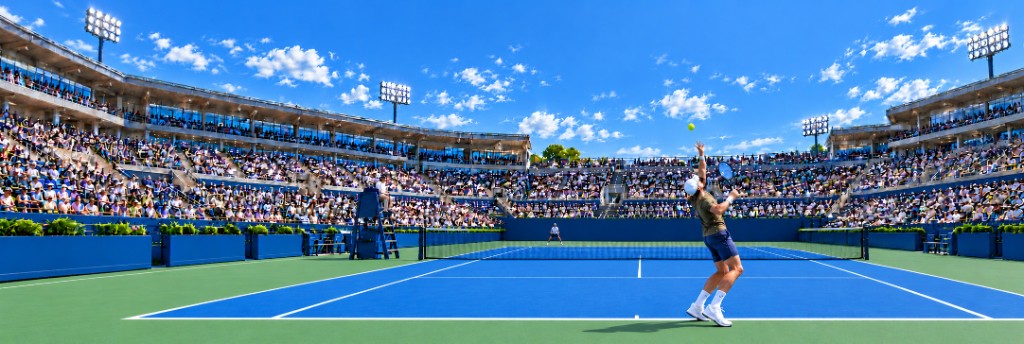
A heavy forehand can look easy. The shoulders turn, the racket falls, and the ball leaves the strings already spinning. That connection is what a racket loop is for. It joins the preparation to the acceleration, so the stroke arrives at the ball as one movement.
Roger Federer, Rafael Nadal, Jannik Sinner, and Carlos Alcaraz do not share one swing shape. They do share a question worth asking of any forehand: does the preparation put the racket where the forward swing can actually use it?
What a racket loop is
The loop is the curve the racket takes while the player prepares, and the way that curve turns into the swing toward the ball. On a typical topspin forehand the racket starts above the lowest point it will reach, drops, then moves forward and up into contact.
It does not have to be a big circle. Grip, the incoming ball, and how much time the player has all change the shape.
A review by Machar Reid, Bruce Elliott, and Miguel Crespo found that pelvis, trunk, and upper-arm movement account for a large share of forehand racket speed. The loop sits inside that chain. It does not create the pace on its own.
Ready, set, then loop
One useful order is ready, set, then loop. From the ready position the player turns the shoulders and takes the racket out to the side. That side position is the set. The player can hold it while the feet finish the move, then start the loop as the ball arrives.
The set is a place to prepare. It is not automatically the end of the backswing. Holding there is different from stopping the racket after it has already dropped. How much the turn, the footwork, and the loop overlap depends on the ball.
A player can also turn and loop in one motion straight from ready, with no pause in between. Both patterns start with a body turn. The choice is about rhythm and the time the ball allows.
Let the racket drop
If the racket is prepared fairly high, it has room to fall. Gravity can help that drop, so the arm does not have to shove the racket downward. On a topspin shot, the drop puts the racket under the contact the player wants, before the swing travels forward and up.
Gravity helps the drop. Most of the hitting speed still comes from the rotation of the body and from the arm. The racket is in the hand, so the drop is guided, not a free fall. A workable cue is to let the racket drop, then accelerate through, with the two parts blending.
Higher preparation is not automatically better. The height and the size of the loop should match the ball, the time, and the player’s own stroke. A fast ball often calls for a shorter preparation.
Why the change of direction matters
A familiar club pattern is to take the racket back, freeze it behind the body, and then hurry it at the ball. The stroke feels split in two, and the arm ends up doing work the body should have shared.
A timed transition can tie the body’s rotation to the racket as it speeds up. Biomechanics research also describes a benefit when a muscle is stretched and then shortens promptly. A delay cuts into that benefit.
That does not mean the racket may never pause. A player can get ready early, wait in the set, and still loop and accelerate well. What matters is when the muscles load, not whether the racket looks like it never stopped.
The aim is a prepared position, and then a smooth release at the right moment.
Federer: watch the connection
Federer’s forehand is a clear place to watch the shoulder turn, the racket’s preparation, and contact as one sequence. The swing looks smooth because those parts meet. The lesson is not to draw a bigger circle. It is to connect the turn to the swing, instead of swinging the arm as a separate piece.
Nadal: the finish is not the loop
Nadal’s forehand is known for racket speed and topspin. The finish up over the head is easy to copy, and it happens after the ball has left the strings. That finish is not the loop that prepared the shot.
The part worth studying is the path into the ball. Matching the finish by itself will not produce his spin or his control.
Sinner: a heavy ball does not need a big circle
Sinner is a useful check on the idea that a heavy ball needs a conspicuous circle. His preparation can stay compact, and the acceleration can still be sharp.
Watch how the body turns, how the arm moves, and where contact happens. For a recreational player the test is simpler: does the preparation leave enough time to speed the racket up without a last-second rush?
Alcaraz: pace and spin together
Alcaraz is a reminder to look at pace and spin together. An ATP review of his 2024 season reported above-average speed and spin on the topspin forehand. Those numbers describe how well he strikes the ball. They do not show that one loop shape is the cause.
The coaching point is to set up the swing so the player can hit decisively and still keep balance and spacing.
These four readings are coaching interpretations. They are not a measurement of whose loop is larger.
The high elbow is a follow-through, not a pose
On many topspin forehands the hitting elbow climbs as the arm wraps across the body after contact. It can end near face height even when the racket itself finishes lower, around the opposite shoulder. A high elbow and a high racket are not the same finish.
For club players that rise can be a sign the follow-through was allowed to continue, rather than stopped short. The arm and the racket slow down through the follow-through. They do not keep speeding up.
The elbow should come up with the swing, not be lifted toward the face on purpose. Where it ends depends on contact height, direction, and the kind of forehand. It is a common pattern, not a required pose. Backhands finish differently.
A second loop, back toward ready

There is a second loop, after the shot. Coach Robert Exell describes a recovery in which the racket keeps moving out of the follow-through, dips around the body — sometimes passing almost behind the player — and rises back toward ready in one motion. He points to Sinner and Nadal as examples.
That recovery loop is not the backswing. It joins the end of one shot to the start of the next, instead of treating the finish as a full stop.
Exell’s reading is that the flowing path may get a player back to ready sooner, because it skips a separate stop and reset. A transcript of Top Tennis Training’s Sinner forehand lesson describes a similar move behind the back that comes back out in front, around the 6:25 mark. That supports the shape of the pattern. It does not time how fast the player recovers.
A search for a study that times this loop against a stop-and-reset recovery did not turn one up. The idea that it is faster remains Exell’s observation, and a claim that still needs a test. High-speed video could measure the time from contact to a ready position defined the same way on comparable shots.
The racket still slows after contact, and the path has to fit the time left. A quick reply may need a shorter way home. Racket recovery also has to work with the feet, so the player is balanced and ready for either side.
The backhand has a loop too
Plenty of topspin backhands use a curve and a drop too. Federer’s one-handed backhand and the two-handed backhands of Nadal, Sinner, and Alcaraz are different versions of that idea.
The shape is not fixed. A slice or a blocked return takes another path, and a fast ball can force a much shorter preparation.
What to practice
Start with feeds you can handle. Turn early, keep your spacing, and let the racket move into the forward swing without a flicked wrist. Get the contact clean before you add pace.
Then change the feeds. Shorten the preparation when the ball is faster, and give the loop more time when it is slower. A loop that only works on a perfect feed is not a match stroke yet.
Federer, Nadal, Sinner, and Alcaraz give four different swings to watch. The common lesson is timing: get ready early enough, change direction smoothly, and accelerate toward the ball.
The useful loop is the one you can repeat.
Sources
- Reid, Elliott, and Crespo, “Mechanics and Learning Practices Associated with the Tennis Forehand: A Review,” Journal of Sports Science and Medicine, 2013
- Elliott, “Biomechanics and tennis,” British Journal of Sports Medicine, 2006
- Love Tennis / Top Tennis Training, “Rafael Nadal Forehand Slow Motion,” 2020
- ATP Tour, “How Carlos Alcaraz is ‘pushing opponents to the limit,’” 2024
- Top Tennis Training, “Jannik Sinner Forehand Lesson – 3 Vital Tennis Tips,” 2024, follow-through from about 6:05 and especially around 6:25. Transcript via Lilys; the video frames were not independently checked.