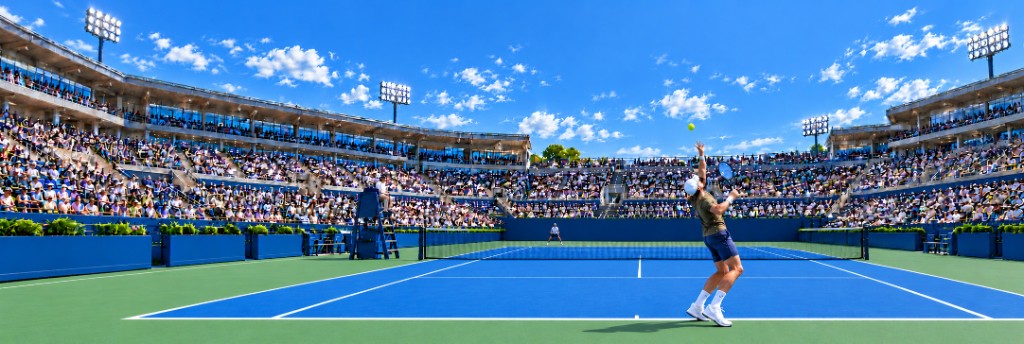
Jannik Sinner’s forehand raises two fascinating questions: is it the best the sport has seen, and could its distinctive mechanics become a model for the next generation?
A third detail deserves attention: what happens after the ball has gone. Once the racquet wraps across the body, Sinner’s return toward the ready position can form another loop. That movement connects the finished shot with preparation for the next one.
Is it the best forehand ever?
Sinner has a credible place in that discussion. Declaring him the winner, however, would require more than identifying an impressive swing or a high ball speed.
In an ATP report published on September 11, 2024, Sinner led the Tennis Data Innovations forehand shot-quality rankings at 8.8 out of 10. His reported average forehand speed was 78 mph, five mph above the Tour average in that analysis. Source: ATP/Tennis Data Innovations.
Those figures establish excellence within that dataset. They do not provide a historical comparison with peak Federer, Nadal, Agassi or every other great forehand. A contemporary shot-quality rating cannot settle an all-time ranking.
My assessment is that Sinner’s combination of pace, repeatability and baseline pressure makes his forehand one of the strongest candidates of the modern era. “Best ever” remains a judgement about the value of different strengths, surfaces and situations.
What is mechanically different?
The distinction needs to be drawn carefully: Sinner still uses a unit turn. Turning the shoulders and preparing the body are separate from the size and shape of the racquet’s backswing. A player can use an economical racquet preparation while making a substantial body turn.
Biomechanist Brian Gordon’s published 2022 analysis describes Sinner as a hybrid: an elbow-led positional backswing combined with a bent-arm forward swing. Gordon highlights the racquet’s orientation toward the end of preparation and how it suits that hitting structure. This is a useful technical description, rather than evidence that Sinner has invented a wholly new stroke. Source: Brian Gordon’s Sinner analysis.
The visual impression is of preparation directed toward an effective hitting position, followed by rapid acceleration. The important distinction is not simply “small loop versus big loop.” It is how the preparation, arm structure and body movement fit together.
Federer, Nadal and Djokovic are not one identical model
Federer and Nadal commonly use a straighter hitting arm around contact. Djokovic typically uses a bent elbow, making him closer to Sinner on that particular feature. Arm structure also changes with the demands of a shot; these are tendencies, not rigid positions on every ball. Source: Pat Cash’s forehand comparison.
Federer himself has been used as a model of a compact outside backswing in Brian Gordon’s research-based teaching. That complicates the idea that the previous generation all depended on a large looping preparation. Source: TennisPlayer’s introduction to Gordon’s forehand analysis.
A raised racquet head and a subsequent drop can be part of an effective preparation. But grouping all three champions together as users of one “big gravity drop” understates their differences—and understates the active mechanics of the stroke.
How much does gravity contribute?
Gravity acts on the racquet and can assist its downward movement. It does not explain the full acceleration into the ball.
Forehand biomechanics research identifies contributions from trunk movement, shoulder actions and movements of the arm and hand. Their interaction, timing and racquet orientation matter. A large visible drop is not a measurement of how much useful speed the player will produce at contact. Source: Reid, Elliott and Crespo, “Mechanics and Learning Practices Associated with the Tennis Forehand.”
The coaching question is therefore whether the preparation supports reliable contact under time pressure. Its appearance alone cannot establish superiority.
The second loop: finishing the shot and returning to ready
The return loop is easiest to notice on forehands where the racquet travels across the body and around or beyond the opposite shoulder. From that finish, its path back toward the front of the body can form a second curved movement.
Calling it the second loop is a useful descriptive coaching label. Here, it means the recovery path after the hitting swing—not another backswing and not a recognised, separately proven power mechanism.
A plausible mechanical explanation is that the arm and racquet are being guided out of the follow-through into the next ready position. This is an interpretation of the movement, not a measured finding that the loop saves a specific amount of time or reduces joint loading.
Because the ball has already left the strings, the recovery loop cannot add speed or spin to that ball. Its potential value concerns readiness for the next shot.
Nor should every player deliberately make a circle behind the shoulder. Follow-through and recovery vary with contact height, direction, balance and the next movement. The practical cue is: finish freely, then bring the racquet back into readiness as you recover your position.
A coach could evaluate the pattern by filming several rallies and checking whether the player is balanced, has the racquet available and times the next split step effectively. That would be more informative than judging the prettiness of the loop.
Could this become a revolution like the two-handed backhand?
The backhand comparison is thought-provoking. In February 2024, the ATP reported that the men’s Top 10 would contain no one-handed backhands for the first time in rankings history—a striking milestone in a long generational shift. Source: ATP.
Sinner’s forehand represents a different kind of possible change. The contrast is between variations within the modern forehand, rather than a switch from one hand to two. Elements of compact preparation and bent-arm hitting already existed before him.
My forecast is that his success will encourage coaches to examine economical preparation, effective contact positions and recovery more closely. It does not establish that professionals will all adopt his precise backswing or return loop.
Different grips, bodies and tactical demands will continue to support different forehands. A player seeking heavy topspin from well behind the baseline may solve the stroke differently from one trying to take time away near it.
What should players learn from Sinner?
The most useful lesson is to study the function of the movement. Prepare early, organise the body and racquet for the incoming ball, accelerate through an appropriate contact position and recover for the next shot.
Research also cautions against expecting one identical swing under every condition. Players adapt their mechanics to incoming speed, spin, height and target. Good practice should develop that adaptability. Source: Bruce Elliott, “Biomechanics and tennis.”
Sinner offers an outstanding model to study, but copying the outline of his swing cannot reproduce his timing or ball striking. His forehand may influence the next generation most through the questions it raises: how much preparation does a player need, how efficiently can they reach contact, and how smoothly can one shot lead into the next?
Technical descriptions draw on the cited analysis and general biomechanics research. The second-loop explanation and forecast of future adoption are coaching interpretations. Performance figures are dated snapshots, not current or all-time rankings. Research checked October 11, 2026.
Sources
- ATP/Tennis Data Innovations, Sinner 2024 insights
- Brian Gordon’s Sinner analysis, TennisPlayer forum, September 2022
- Pat Cash’s forehand comparison
- TennisPlayer’s introduction to Gordon’s forehand analysis
- Reid, Elliott and Crespo, “Mechanics and Learning Practices Associated with the Tennis Forehand”
- ATP, no one-handed backhands in the Top 10, February 2024
- Bruce Elliott, “Biomechanics and tennis”