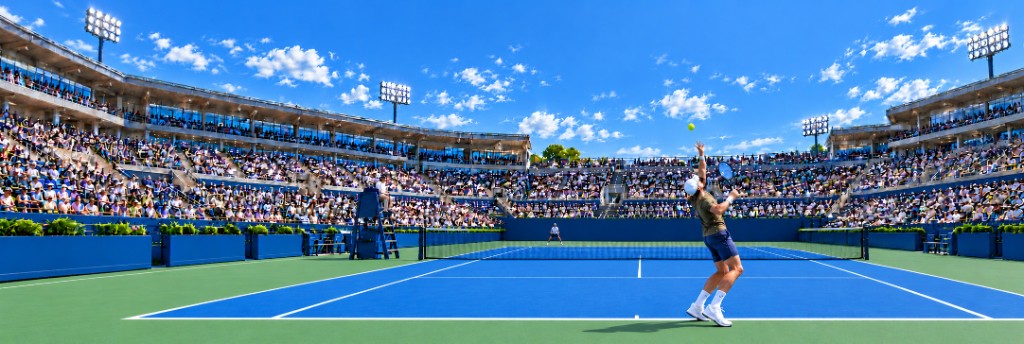
I wish I could meet Roger Federer and thank him personally for making tennis—and the world—a better place.
That may sound like a large statement about someone who played a sport for a living. But Federer’s contribution reaches beyond the matches he won. He brought beauty to tennis, gave fans years of enjoyment and used his success to help children gain opportunities through education.
Is he the most respected athlete in the world? There is no definitive way to measure that. Many athletes deserve consideration. But Federer has a compelling claim to a place among them.
A game that made people stop and watch
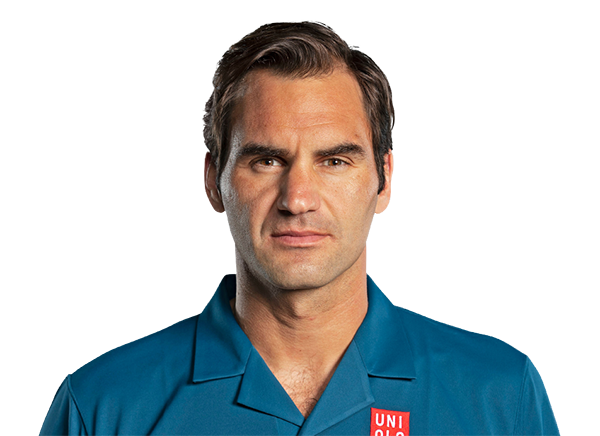
Watching Federer could make you appreciate tennis in a different way.
His balance, timing, variety and movement made difficult shots appear remarkably natural. A forehand could be forceful without looking strained. A volley could be delicate and decisive. His serve could create an opening through placement and disguise.
For players and coaches, there was always something to study. For someone unfamiliar with tennis, there was simply the pleasure of watching an extraordinary athlete at work.
The apparent ease could obscure the demands of the game. Behind that graceful style were preparation, physical effort and decisions made under intense pressure.
What I admired was the combination: beautiful tennis played with a fierce desire to win.
A passion that stayed visible
Federer’s love of tennis was part of his appeal.
You could see it in his delight after a well-played point, his disappointment after a difficult loss and the emotion of his farewell. He cared deeply about the game and what it allowed him to experience.
His final professional match came at the 2022 Laver Cup, playing doubles alongside Rafael Nadal. It was a fitting setting for a farewell that brought together competition, friendship and gratitude.
For those of us who play tennis, that attachment is familiar. The game can challenge and frustrate us, yet keep drawing us back.
Federer expressed that connection on the biggest stages. Even when the stakes were enormous, there were moments when his enjoyment of playing shone through.
Respect from the people across the net
Popularity and respect are related, but they are not identical.
Fans see the matches and public appearances. Fellow players experience the competition directly. Their assessment carries particular weight.
Federer received the Stefan Edberg Sportsmanship Award thirteen times, voted by his peers. He also won the ATP Fans’ Favourite singles award nineteen consecutive times, from 2003 through 2021.
Those awards cannot establish that he is the world’s most respected athlete. They provide strong evidence of enduring regard from both competitors and supporters.
Respect also does not require pretending that he was flawless. Federer was an intense competitor who experienced frustration and disappointment. His reputation developed over years, through how he generally conducted himself while pursuing victory.
That makes the recognition from fellow players particularly meaningful. They knew how difficult it was to compete against him, and still repeatedly honoured his sportsmanship.
Rivalry with room for friendship
Federer and Nadal showed that a rivalry could be fierce without becoming hostile.
Their contrasting styles made their matches fascinating. Each challenged the other to find answers, adapt and improve. Yet their final appearance together also revealed the human connection that had developed alongside the competition.
Seeing them share Federer’s farewell was moving because it reflected something larger than a score. Two athletes who had repeatedly challenged each other could appreciate what the other had contributed.
That is a valuable example for sport at every level. You can want to beat an opponent and still respect, like and learn from them.
For young players especially, that lesson deserves as much attention as any forehand or serve.
Family at the centre of the farewell
Federer’s family was a visible part of his tennis life, especially during its closing chapter.
At the Laver Cup farewell, his wife Mirka, their four children and his parents joined him on court.
We cannot know a family’s private life from public moments. But that scene made the importance of those relationships unmistakable.
The tennis world was saying goodbye to a champion. His family was sharing the end of a chapter they had experienced with him.
For me, that gave the occasion its deepest emotional weight. Behind the famous athlete was a husband, father and son, grateful to the people closest to him.
It was a reminder that even the most celebrated sporting careers are supported by relationships that cannot be measured in trophies.
A legacy beyond tennis
Federer’s charitable work gives his legacy another dimension.
Established in 2003, his foundation now focuses on early and foundational learning in southern Africa, alongside movement and play in Switzerland. Its work involves partnerships intended to strengthen children’s opportunities over the long term.
During a February 2025 visit to South Africa, Federer reported that the foundation’s work there had helped provide quality preschool education to more than 300,000 children. That figure referred specifically to South Africa, rather than the foundation’s total reach across all its programmes.
This work also deserves recognition for the local partners, educators and communities who make it possible.
Federer’s role matters because he has directed attention and resources toward children whose achievements may never appear on a sports page. Better preparation for school can have a significance that lasts far beyond a tennis career.
His foundation gives substance to the idea that an athlete’s influence can continue long after the final match.
What I would say to Roger
As a Canadian tennis coach from Vancouver, British Columbia, I have admired Federer from a distance. My closest connection was the opportunity to coach a player who had practised with both Roger Federer and Rafael Nadal—a small connection, but a meaningful one to me.
If I had the opportunity to meet Roger, I would want to say something simple:
Thank you for the joy you brought to tennis. Thank you for showing how fiercely someone can compete while earning the respect of opponents. And thank you for using your success to help children have a better start in life.
As a player and coach, I appreciate what he gave us to watch and learn from. His example also reminds me that the way we participate in sport matters.
The people across the net matter. The families supporting us matter. The opportunities we can create for others matter.
Those are lessons we can carry into our own lives, whatever level of tennis we play.
A place among the most respected
Calling Roger Federer the world’s most respected athlete remains a personal judgment. There is no universal ranking that can settle it.
But the case for his place among the most respected is substantial: enduring affection from fans, repeated recognition from peers, a deep attachment to tennis and a charitable commitment extending beyond retirement.
His achievements earned him a place in tennis history.
The enjoyment he gave people, the respect he earned and the opportunities his foundation helps create explain why someone like me would still wish to meet him—simply to say thank you.
Comments
No comments yet.