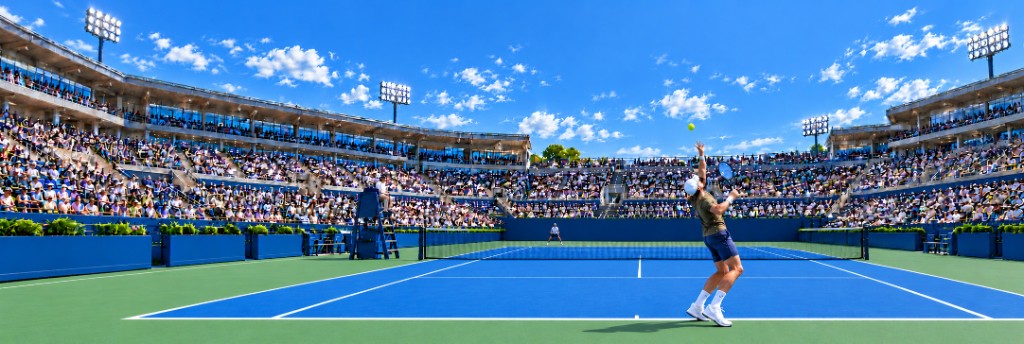
A serve flashing past at 130 miles per hour looks like an act of brute force. In reality, it is a remarkably precise movement: the legs drive, the trunk turns and tilts, and the serving arm accelerates the racquet into the ball.
At 130 mph—approximately 209 km/h—the ball leaves the racquet travelling about 58 metres per second. Producing that speed requires more than a strong arm. It takes coordinated movement, explosive power and clean contact.
But how much of that ability can be taught? When do players develop it? And how many professionals can actually reach that speed?
The biggest servers of the past 20 years
Men’s tennis has seen several very different serving styles during the past two decades. Roddick belongs in that conversation even though his most famous speed reading came in 2004, just before that window.
These are selected milestones—not a ranking of each player’s career maximum.
| Player | Documented milestone |
|---|---|
| Andy Roddick | 155 mph in Davis Cup, 2004 |
| John Isner | 157 mph in Davis Cup, 2016 |
| Ivo Karlovic | 45 aces against Tomas Berdych at Halle, 2015 |
| Sam Groth | 163.4 mph recorded at the Busan Challenger, 2012 |
| Milos Raonic | 47 aces against Cameron Norrie at Queen’s Club, 2024 |
| Juan Martin del Potro | 136 mph in the US Open final, 2018 |
| Nick Kyrgios | 44 aces against Ryan Harrison at Brisbane, 2019 |
| Ben Shelton | 149 mph at the US Open, 2023 |
| Giovanni Mpetshi Perricard | 153 mph at Wimbledon, 2025 |
| Reilly Opelka | 130.6 mph average first-serve speed in ATP’s 2025 analysis |
Sources: ATP player biographies, tournament notes and statistical reports; official US Open reporting. Groth’s Challenger reading is identified separately from tour-level records. www.atptour.com
Andy Roddick: explosive speed without giant height

At 6 ft 2 in (188 cm), Roddick was tall, but he was not built on the same scale as the tallest serving specialists. His 155 mph Davis Cup serve demonstrated that exceptional speed did not require an exceptionally tall frame. www.atptour.com
His abbreviated service motion became one of tennis’s most recognisable deliveries. Young players copied it in the hope of finding extra speed. The lesson, however, is not that everyone should reproduce its appearance. A short preparation can produce enormous racquet speed when the movements are coordinated effectively. www.atptour.com
Roddick’s serve was also much more than a radar-gun attraction. ATP’s career leaderboard lists him as winning 90.1% of his service games. The headline speed was spectacular; the ability to hold repeatedly made it valuable. www.atptour.com
Del Potro and Kyrgios belong in the conversation
Del Potro’s forehand attracted enormous attention, but his serve was another major weapon. The US Open’s official report on the 2018 final against Novak Djokovic documented serves reaching 136 mph. That is a verified match example, rather than a claim about his career maximum. www.usopen.org
His game illustrates the value of combining a powerful delivery with a dangerous first groundstroke. The serve did not need to produce an ace to create an attacking opportunity.
Kyrgios’s 44 aces against Ryan Harrison at Brisbane in 2019 show why he belongs among the era’s outstanding servers. That total came in a best-of-three-set match—evidence of sustained serving effectiveness, rather than one exceptional speed reading. www.atptour.com
For both players, evaluating the serve means looking beyond maximum velocity to what the delivery accomplishes during a match.
What actually produces a 130 mph serve?
The grip and toss establish the foundation
A continental grip allows players to develop flat and spin serves without switching to a forehand-style grip. A dependable toss lets the player meet the ball in an effective contact position instead of chasing it.
USTA’s serving guidance identifies the grip and toss as foundations of the stroke. If the toss repeatedly pulls a player out of position, producing both speed and accuracy becomes more difficult. www.usta.com
The legs and trunk help drive the motion
The serve uses a chain of linked body movements. The legs help propel the body upward, while the trunk turns and moves in a shoulder-over-shoulder action.
Timing matters. Simply bending the knees more does not automatically add speed. The movements must support the swing that follows. Effective servers coordinate the body rather than asking the arm to produce everything independently. pmc.ncbi.nlm.nih.gov
Shoulder rotation accelerates the racquet
As the player prepares to swing upward, the upper arm externally rotates at the shoulder. During acceleration, it rapidly internally rotates.
Internal shoulder rotation is different from forearm pronation. Shoulder rotation contributes substantially to racquet speed; pronation helps orient the racquet face through the delivery.
Describing the serve simply as a “wrist snap” misses the coordinated action of the shoulder, arm and hand. pmc.ncbi.nlm.nih.gov
Contact height and follow-through complete the delivery
A higher contact point improves the geometry of clearing the net and landing the ball in the service box. This helps explain the advantage enjoyed by tall servers, although height alone cannot create racquet speed.
The movement also continues after contact. Deceleration and the finish are part of the serve. Kovacs and Ellenbecker’s eight-stage model evaluates preparation, acceleration and follow-through as a complete action. pmc.ncbi.nlm.nih.gov
Is it coachable—or do you have to be gifted?
Serve speed is trainable. A 130 mph outcome is not guaranteed.
A controlled study of 30 nationally ranked male juniors provides a useful example. The training group completed six weeks of core, elastic-resistance and medicine-ball work.
Its average measured serve speed rose from 150.3 to 157.9 km/h—approximately 93.4 to 98.1 mph. That represents a gain of about 4.7 mph. The control group changed much less, and the training group’s serve accuracy did not change significantly. www.jssm.org
That demonstrates improvement. It does not promise that the same programme will turn a 110 mph server into a 130 mph server. The participants were juniors, the intervention was short, and individual responses differ.
Physical characteristics matter too. Research on competitive young players has found associations between serve speed and height, arm span, body mass, grip strength and medicine-ball throwing performance. Those relationships help explain differences between players, but no single measurement establishes a player’s ceiling. pmc.ncbi.nlm.nih.gov
The practical coaching conclusion is to develop mechanics and physical capacity together. One player may have substantial untapped speed; another may already be close to what their body and technique can produce. Height alone cannot tell a coach which is which.
When do players start serving at 130 mph?
There is no established age at which a developing player should reach 130 mph. Biological maturation, training history and coordination vary too much for a universal deadline.
Exceptional young adults can already produce extraordinary speed:
- Shelton hit 149 mph at age 20 at the 2023 US Open.
- Mpetshi Perricard hit 153 mph at age 21 at Wimbledon in 2025.
These are ages at documented performances—not evidence of when either player first crossed 130 mph. www.usopen.org
For perspective, a study of 27 academy players reported a male subgroup averaging about 15.7 years old with a mean serve speed of roughly 175 km/h, or 109 mph. That small sample is not a universal junior benchmark, but it illustrates how far 130 mph sits above the mean in at least one competitive adolescent group. pmc.ncbi.nlm.nih.gov
For juniors, a repeatable motion, dependable placement and reliable second serve are more useful development goals than reaching a particular speed by a particular birthday.
How many players can hit over 130 mph today?
There is no verified worldwide count in the public sources reviewed for this article.
Maximum-speed data are published unevenly across events. “Can hit 130” could also mean a practice reading, a fault, one legal match serve or a regularly used delivery.
Official reporting shows that the ability extends beyond the most famous serving specialists. At the 2025 Australian Open, Alex de Minaur recorded 217 km/h—about 135 mph. He matched Matteo Berrettini and Tommy Paul at that stage of the tournament, while Taylor Fritz and Alexander Zverev had recorded slightly faster serves.
Those five players alone exceeded 130 mph. That is an illustrative group, not a complete count. ausopen.com
A more revealing statistic answers a different question: Who averages above 130 mph?
| Player | Average first-serve speed, 2025 |
|---|---|
| Giovanni Mpetshi Perricard | 134.4 mph |
| Reilly Opelka | 130.6 mph |
| Raphael Collignon | 128.9 mph |
| Alexander Zverev | 128.8 mph |
| Jakub Mensik | 128.6 mph |
ATP’s published analysis of the completed 2025 season placed Mpetshi Perricard and Opelka above 130 mph in average first-serve speed. These figures describe season averages, not career maximums or a census of current players. www.atptour.com
A player averaging below 130 can still hit individual serves above it. The two-player figure must therefore never be presented as the number of professionals capable of reaching 130.
The fastest serve does not always win the point
Mpetshi Perricard’s 153 mph Wimbledon serve offers a perfect reminder: Taylor Fritz returned it—and won the point. www.atptour.com
A fast serve becomes a great serve through placement, spin, disguise and repeatability. The right delivery can jam a returner, pull them off court or create an attacking first groundstroke.
The enduring lesson from Roddick, Del Potro, Kyrgios and today’s biggest servers is that physical advantages and developed skill work together. Coaching can make a serve faster and more effective. The scoreboard rewards what that serve accomplishes.
Research checked October 11, 2026. Historical milestones retain their event dates; 2025 is the completed season used for the published average-speed comparison.