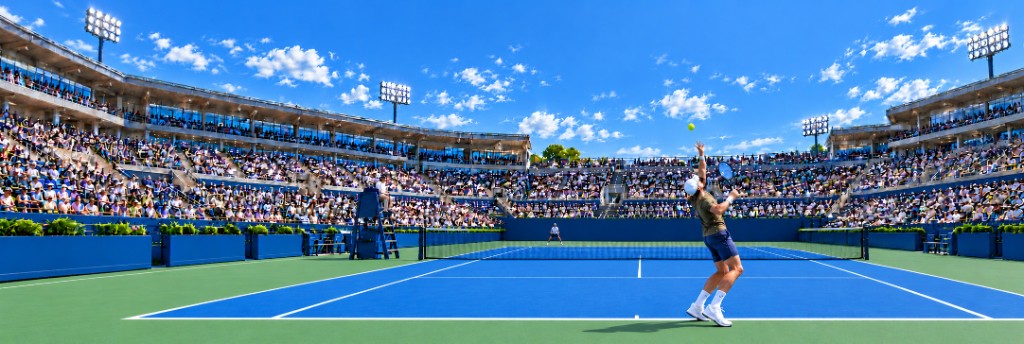
A heavy forehand drives the opponent behind the baseline. The next swing looks the same, until the ball dies just over the net. That is the drop shot, and Carlos Alcaraz has made it part of how the modern game is played.
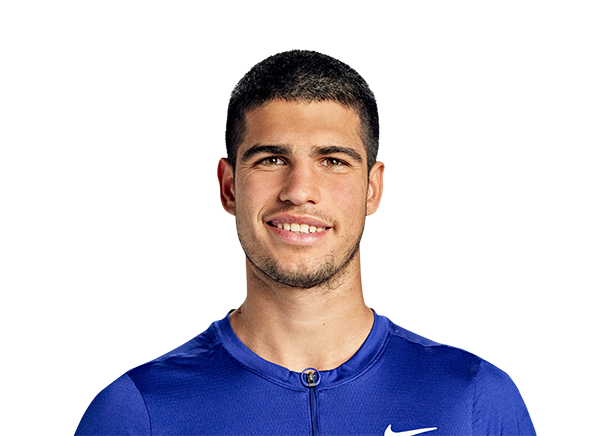
Are the pros hitting more of them? There is evidence that leading men started using the forehand drop shot more after Alcaraz arrived. That is a narrower claim than saying every player, on both tours, is hitting more drop shots every season. The revival is still real enough to notice.
An ATP analysis in 2023 found more forehand drop shots among the Top 100 after Alcaraz’s rise in 2021. It pointed to players including Casper Ruud, Taylor Fritz, Jannik Sinner, Frances Tiafoe, and Alexander Bublik. The same look found that his peers were using the shot more often and winning fewer of those points. Copying the swing is easier than copying the situation that makes it work.
Power makes the space
Alcaraz builds that situation with pace. His groundstrokes push people back, and the open court is then in front of them. The take-back looks like another heavy ball, so the soft one arrives late. Roland-Garros looked at Alcaraz and Ons Jabeur in 2023 and landed on the same idea: force, disguise, and an empty patch of court.
The defender has a bad choice. Stay deep for the heavy ball and risk a full sprint forward, or step in and give the next drive more time. The point stops being only side to side. It runs the length of the court.
Alcaraz is unusual in how often he tries it and how often the point goes his way. In a March 2024 study of volunteer-charted men’s matches, Tennis Abstract’s Jeff Sackmann found Alcaraz attempting a baseline drop shot on 5.4 percent of his points and winning 62.1 percent of those points. Across the wider sample, players won 53.8 percent of points when they tried one. Those numbers come from that study. They are not a count of every match on tour.
A drop-shot point does not have to end with a ball the opponent never touches. They can get there and still leave a pass, a volley, or a lob.
Touch, and the cost of missing
Jabeur has shown another way to use it. Her game is built on variety more than on Alcaraz’s pace. At the 2025 Australian Open, the WTA highlighted a drop shot against Emma Navarro that set up a forehand pass. The soft ball started the point. It did not have to finish it.
Bublik took the idea to an extreme at Roland-Garros in 2025. Reuters counted 37 drop shots in his fourth-round win over Jack Draper. One match can show how disruptive the shot is. It cannot, by itself, prove that the whole tour has changed.
A bad one is expensive. A ball that sits up is an invitation. A shot the opponent can read loses the surprise. Trying to place it while stretched or backing up is a different skill from hitting it on balance.
For club players, the useful part is the setup, not only the touch. Look for balance, an opponent standing deep, and a swing that does not announce the plan. Then be ready for the next ball. Getting to a drop shot does not mean the point is saved.
The shot is back because power creates the space and touch takes it. Alcaraz and Jabeur have made that exchange worth watching. The question is no longer whether a drop shot belongs. It is whether a player can see the moment when taking pace off the ball puts on the most pressure.
Sources
- ATP Tour, “What shot has Carlos Alcaraz popularised?,” 2023
- Roland-Garros, “Jabeur, Alcaraz drop shots: What makes them unique?,” May 31, 2023
- Tennis Abstract, “Effects and After-Effects of the Carlos Alcaraz Drop Shot,” March 21, 2024
- WTA, “Showtime! Jabeur entertains Melbourne crowds with hot shots,” Jan. 18, 2025
- Reuters, “Risky business or lethal weapon? Drop shot in focus after Bublik barrage,” June 3, 2025